How to Start a Pressure Washing Business: The Paperwork, Pricing and Bookkeeping You Need
Short answer: To start a pressure washing business, you need an exterior cleaning service agreement, a pre-wash inspection report, a property damage waiver, a chemical and water use notice, before and after photos, and an estimate and invoice, plus a way to track chemicals, fuel and mileage. Most jobs are priced by the square foot (or linear foot for fences), adjusted for soft washing or heavy staining, with add-ons on top. Licensing, insurance and wash water rules vary by state and city, so check locally first.
What paperwork do you need to start a pressure washing business?
Pressure washing can etch concrete, strip paint, damage plants and force water where it shouldn't go, so the paperwork is mostly about documenting conditions and setting expectations before any water touches the property.
Before the job
- New client intake: the exterior cleaning request, meaning which surfaces, approximate sizes, water access and photos.
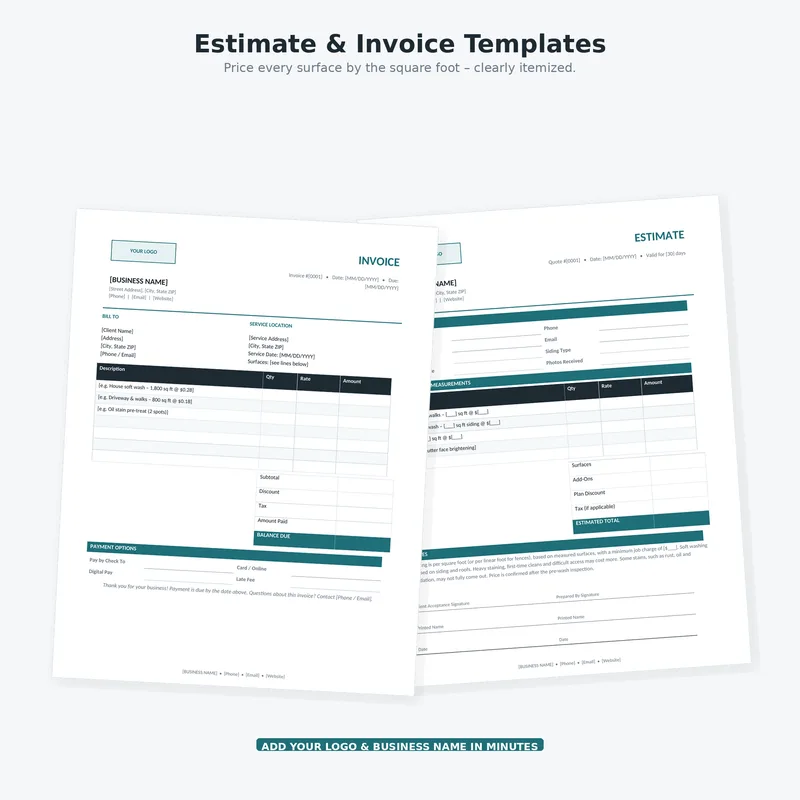
- Estimate: surfaces, measured square or linear feet, method, add-ons and how long the quote is good for.
- Surface pricing guide: a customer-facing service menu priced by the square foot.
- Exterior cleaning service agreement: covers pressure washing and soft washing, including scope, price, payment, scheduling and limits of what cleaning can achieve. Not every stain comes out.
- Pre-wash inspection and property condition report: document existing cracks, loose paint, oxidation and damage before you start.
- Property damage waiver for the known risks of pressure and soft washing.
- Chemical and water use notice: tells the client what you use, how you protect plants and property, and where the water goes.
On the job and after
- Pressure washing job checklist for setup, the wash and the final walkthrough.
- Before and after photo record: proof of results and protection against damage claims.
- Invoice and a cancellation, weather and payment policy, plus a feedback form.
Do you need a license or insurance to start a pressure washing business?
Many places require a general business license or registration. Some states or cities may treat certain exterior cleaning work as contracting, and commercial jobs may come with their own requirements. Check with your city, county and state. The SBA's Launch your business guide gives a general overview of registration, tax IDs and licenses.
Wash water is the trade-specific question. Cities and counties manage storm drain systems, and the EPA describes how municipal stormwater programs are regulated on its stormwater discharges from municipal sources page. Before you wash driveways, parking lots or buildings, ask your local public works or stormwater office what rules apply to wash water and cleaning chemicals reaching storm drains, and follow the label on every chemical you use.
For insurance, talk to a licensed agent about general liability coverage. Damage to siding, windows, paint or plants is a real risk in this trade, and commercial clients often ask for proof of insurance. Ask about commercial auto too if you tow a trailer.
Requirements vary by state, county and city. Check with your state and local licensing offices before you take paid jobs. This is general information, not legal or insurance advice.
How do you price pressure washing jobs?
Pressure washing is usually priced by area: square feet for flat surfaces and siding, linear feet for fences. The kit's calculator works in this order:
- Measure each surface. Enter square feet for driveways and sidewalks, one-story and two-story house washes, decks, patios and pavers, and roof soft washes, plus linear feet for fences. Each surface has its own rate because each takes different time, chemicals and risk.
- Method and condition multiplier. A standard pressure wash is 1.0. Soft washing (low pressure), heavy staining or a first-time clean, and commercial or after-hours work each get a multiplier.
- Maintenance plan discount for annual or semi-annual residential plans and quarterly or monthly commercial plans.
- Add-ons like gutter face brightening, an exterior window rinse, rust or oil stain treatment, concrete sealing, gum removal, patio furniture washing or a dumpster pad clean.
- Minimum job price so a small patio is still worth hauling the rig out.
- Profitability check. The sheet subtracts a chemicals and fuel percentage, divides by the hours from setup to cleanup, and compares the result to your target hourly rate.
Worked example: how the kit's calculator adds it up
Example numbers only. These are the placeholder rates that come pre-filled in the workbook so you can see how the math flows. They are not market prices or a recommendation. Replace them with rates based on your own costs and your local market.
| Driveway / sidewalks (concrete): 800 sq ft × $0.18 | $144.00 |
| House wash – 2 story: 1,800 sq ft × $0.28 | $504.00 |
| Method / condition: Soft wash (low pressure) (× 1.1) | $712.80 |
| Frequency: One-Time (no adjustment) | $712.80 |
| Add-on: Gutter face brightening ($75.00) | + $75.00 |
| Quote price (never below the $175.00 minimum) | $787.80 |
| Est. chemicals & fuel (10% of price) | − $78.78 |
| Net after job costs | $709.02 |
| ÷ 4 estimated hours on site | $177.26/hr |
| vs. example target of $75.00/hr | At or above target |
Measure, don't eyeball. Pacing out a driveway or using the satellite view in a map app gets you close, and you can confirm on site with a measuring wheel. Write the measurements on the estimate so the client can see where the price came from.
When you're new, it's tempting to undercut other companies to win jobs. Set your rates from your real costs (chemicals, fuel, equipment repairs, water, insurance) and the hourly rate you need, then compare them with local services. The hourly check tells you how low you can go before the job stops paying.
How do you track income, expenses and mileage for a pressure washing business?
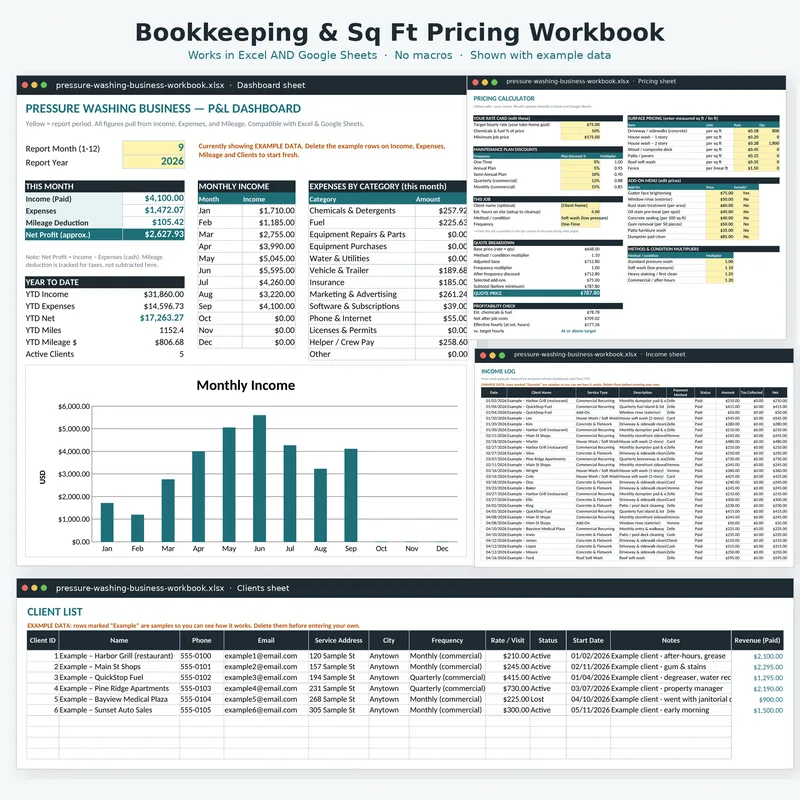
Your biggest variable costs are chemicals, fuel and equipment repairs, and they're easy to lose track of. Log every paid job, every expense and every business trip each week. The workbook's income, expense and mileage tabs roll into a monthly profit and loss dashboard, and the income types (house wash or soft wash, concrete and flatwork, deck and fence, roof soft wash, commercial recurring) show which services actually make you money.
Keep chemical and fuel receipts on a separate business card, and keep the before and after photos for each job with that job's invoice.
What should go in each log?
- Income log: one row per paid job: date, client, service type, payment method, status (paid or unpaid) and amount. In this kit the service types are pre-set to House Wash / Soft Wash, Concrete & Flatwork, Deck & Fence, Roof Soft Wash, Commercial Recurring, Add-On and Other, so you can see which kind of work brings in the most.
- Expense log: date, vendor, category, amount, and whether you kept the receipt. The kit's categories are Chemicals & Detergents, Fuel, Equipment Repairs & Parts, Equipment Purchases, Water & Utilities, Vehicle & Trailer, Insurance, Marketing & Advertising, Software & Subscriptions, Phone & Internet, Licenses & Permits, Helper / Crew Pay and Other.
- Mileage log: date, from, to, purpose and miles. The sheet multiplies miles by a rate you enter.
The IRS publishes a standard mileage rate and changes it from time to time. On its standard mileage rates page (checked October 2026), the business rate is 72.5 cents per mile for January 1 to June 30, 2026 and 76 cents per mile for July 1 to December 31, 2026. The workbook ships with an example rate, so type in the rate that applies to your trips. Whether you can use the standard rate at all depends on your situation, so ask a tax professional.
For what records to keep, the IRS page What kind of records should I keep says your books must show your gross income and your deductions, backed by documents like invoices, receipts and bank statements. Self-employed people generally file Schedule C and may need to pay estimated tax each quarter; see the IRS Self-Employed Individuals Tax Center. This is general information, not tax advice.
Step-by-step: how do you start a pressure washing business?
- Decide which surfaces you'll clean at first, and which ones (like roofs or commercial jobs) you'll hold off on until you have the experience, equipment and insurance for them.
- Check business license and registration rules for your city, county and state.
- Ask your local public works or stormwater office about wash water and chemical rules.
- Talk to a licensed insurance agent about general liability coverage, and commercial auto if you tow a trailer.
- Open a separate business bank account or card.
- Set your per-square-foot and per-linear-foot rates, multipliers, plan discounts, add-ons and minimum from your costs and target hourly rate.
- Fill in your service agreement, damage waiver and chemical and water use notice, and have a local attorney review them.
- Brand your estimate, surface pricing guide, invoice and checklists.
- Set up your income, expense and mileage logs, and delete the example data.
- On every job: measure, inspect and photograph, get signatures, wash, photograph again, walk through and invoice.
What's in the Pressure Washing Business Kit?
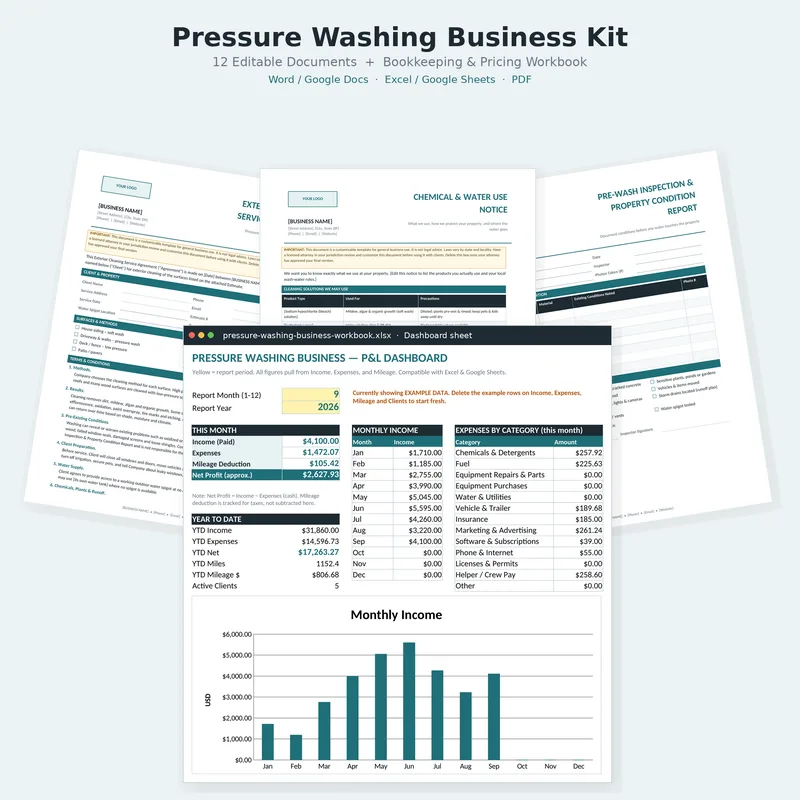
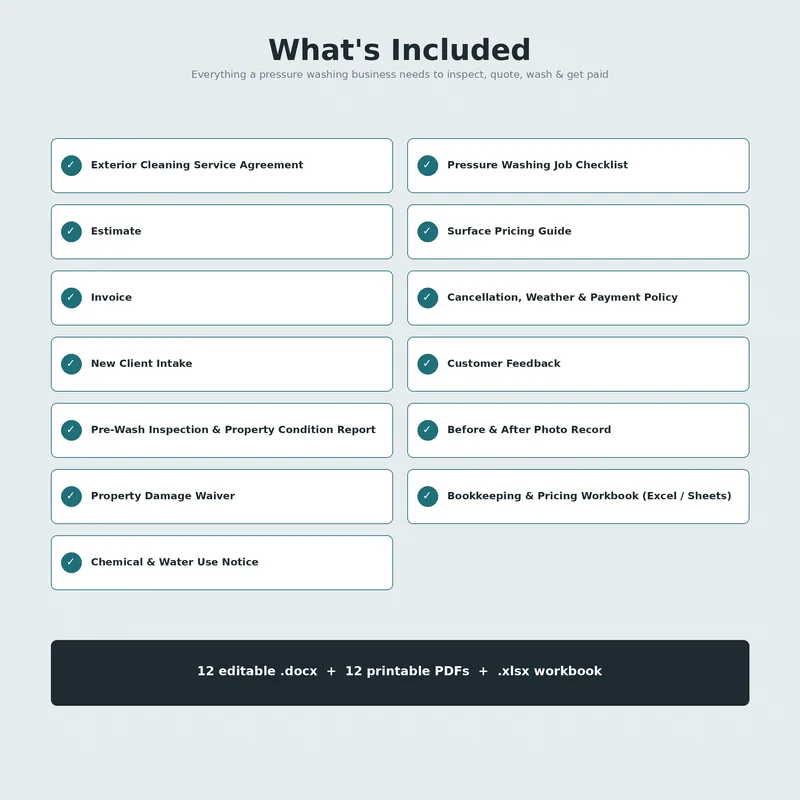
Everything a pressure washing or soft washing business needs to inspect, quote by the square foot, wash, document results and get paid: 12 editable documents plus a square-foot pricing and bookkeeping workbook for Excel and Google Sheets.
$19.99 · instant digital download · nothing is shipped
Same files on both stores. Pick whichever you already use.
Documents (12 editable Word files + matching PDFs)
- Exterior Cleaning Service Agreement – Pressure Washing & Soft Washing Contract
- Estimate
- Invoice
- New Client Intake – Exterior Cleaning Request
- Pre-Wash Inspection & Property Condition Report – Document conditions before any water touches the property
- Property Damage Waiver – Pressure Washing & Soft Washing Release
- Chemical & Water Use Notice – What we use, how we protect your property, and where the water goes
- Pressure Washing Job Checklist – Setup, wash and walkthrough – every job
- Surface Pricing Guide – Service menu – priced by the square foot
- Cancellation, Weather & Payment Policy
- Customer Feedback
- Before & After Photo Record – Proof of results – and protection against damage claims
Bookkeeping and pricing workbook (.xlsx, Excel and Google Sheets)
- Pricing calculator: concrete, siding, deck, patio, roof and fence rates; soft wash / heavy-stain multipliers; plan discounts; add-ons; target hourly rate
- Income log, expense log and mileage log
- Client list with paid revenue per client
- Monthly profit and loss dashboard with a chart
- Comes filled with clearly labeled example data so you can see how it works (delete it before you start)
- Formulas use only functions that work in both Excel and Google Sheets. No macros.
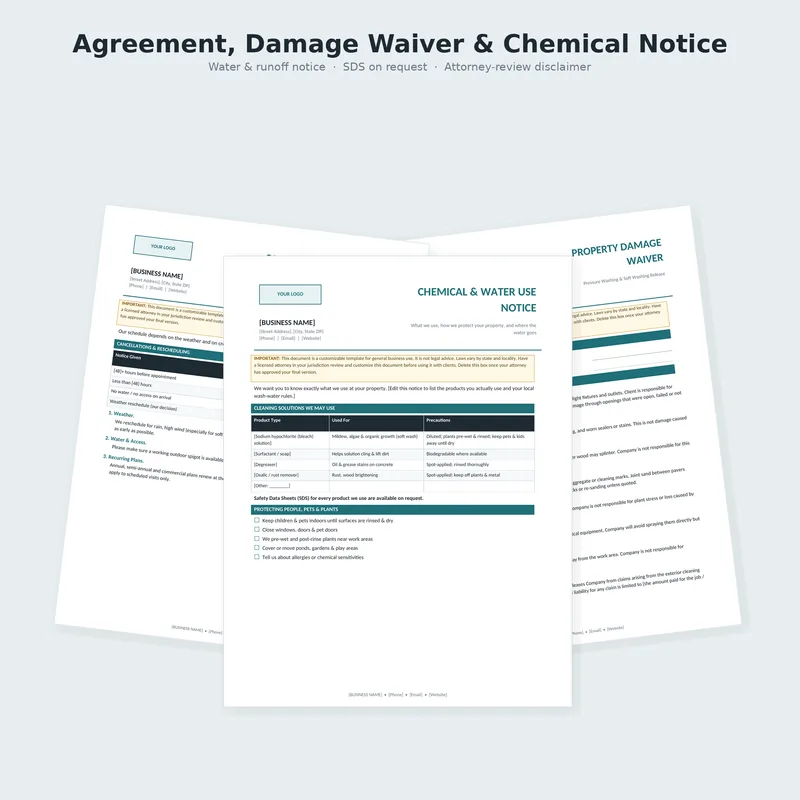
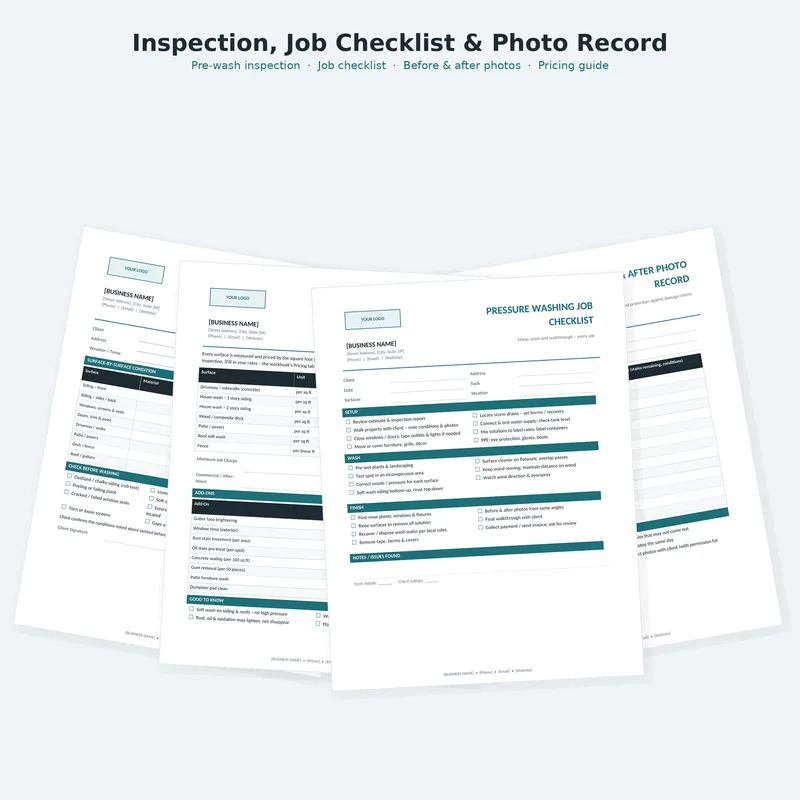
The legal documents are templates, not legal advice. Each one says so on the page. Have a licensed attorney in your state review them before you use them with clients.
Pressure Washing business FAQ
What paperwork does a pressure washing business need?
An exterior cleaning service agreement, an estimate, an invoice, a client intake form, a pre-wash inspection and condition report, a property damage waiver, a chemical and water use notice, a job checklist, a before and after photo record, a surface pricing guide and a cancellation, weather and payment policy.
How do you price pressure washing per square foot?
Measure each surface, multiply by that surface's rate, adjust for soft washing, heavy staining or commercial work, apply any plan discount, add extras and keep a minimum. Then check that the price pays your target hourly rate after chemicals and fuel. Rates vary by area, so set your own.
Do I need a waiver for pressure washing?
A written damage waiver plus a pre-wash inspection and photos make it clear what condition the property was in and what risks the client accepted. Waiver rules vary by state, so have a local attorney review yours.
What's the difference between soft washing and pressure washing?
Soft washing uses low pressure and cleaning solutions for surfaces like siding and roofs, while pressure washing uses high pressure, typically on hard surfaces like concrete. In the kit's calculator soft washing is a separate method with its own multiplier.
Do I need a license to pressure wash?
It depends on your state and city. Many places require a general business license, and some have rules about wash water and storm drains. Check with your local licensing and public works offices.
Where can pressure washing water go?
That's set locally. Ask your city or county public works or stormwater office what's allowed, especially for commercial jobs and any work using chemicals. The kit's chemical and water use notice tells the client what you use and where the water goes.
How do I track pressure washing expenses?
Log chemicals and detergents, fuel, equipment repairs and purchases, water, vehicle and trailer costs, insurance and marketing with dates and receipts. The kit's expense log uses those categories.
Does the workbook work in Google Sheets?
Yes. It's an .xlsx file that uses only functions supported in both Excel and Google Sheets, with no macros.