How to Start a Lawn Care Business: The Paperwork, Pricing and Bookkeeping You Need
Short answer: To start a lawn care business, you need a seasonal service agreement, an estimate and invoice, a route schedule, a per-visit checklist, a property damage waiver and a cancellation and weather policy, plus a way to track fuel, equipment costs and mileage. Most mowing is priced per visit by lot size, adjusted for the service level and how often you come, with add-ons on top. Business licensing and insurance rules vary by state and city, and applying pesticides or fertilizer can require separate certification.
What paperwork do you need to start a lawn care business?
Lawn care runs on recurring visits, so your paperwork has to cover a whole season, not just one job.
Signing up a client
- New client intake: lawn and property information, gate codes, pets and the services they want.
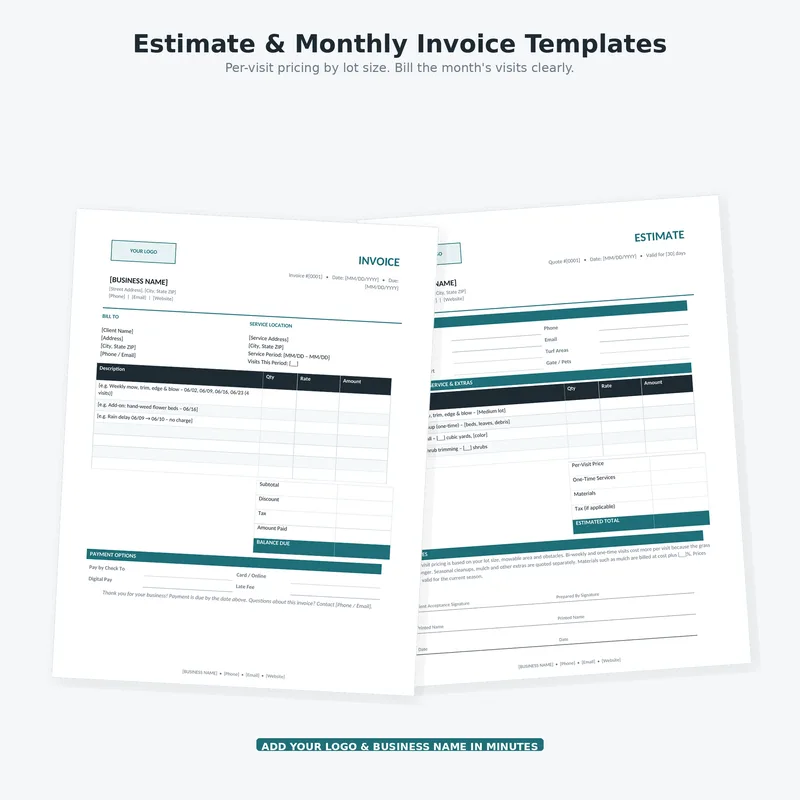
- Estimate: the per-visit price, frequency, add-ons and how long the quote is good for.
- Seasonal lawn care agreement: a recurring maintenance contract covering the service level, the season, price per visit, billing and how either side can end it.
- Property inspection and hazard map: a first-visit walkaround where you mark sprinkler heads, rocks, slopes, dog areas and anything else to avoid before you mow.
- Property damage waiver and hidden objects release: covers damage from objects you couldn't see in the grass.
Running the season
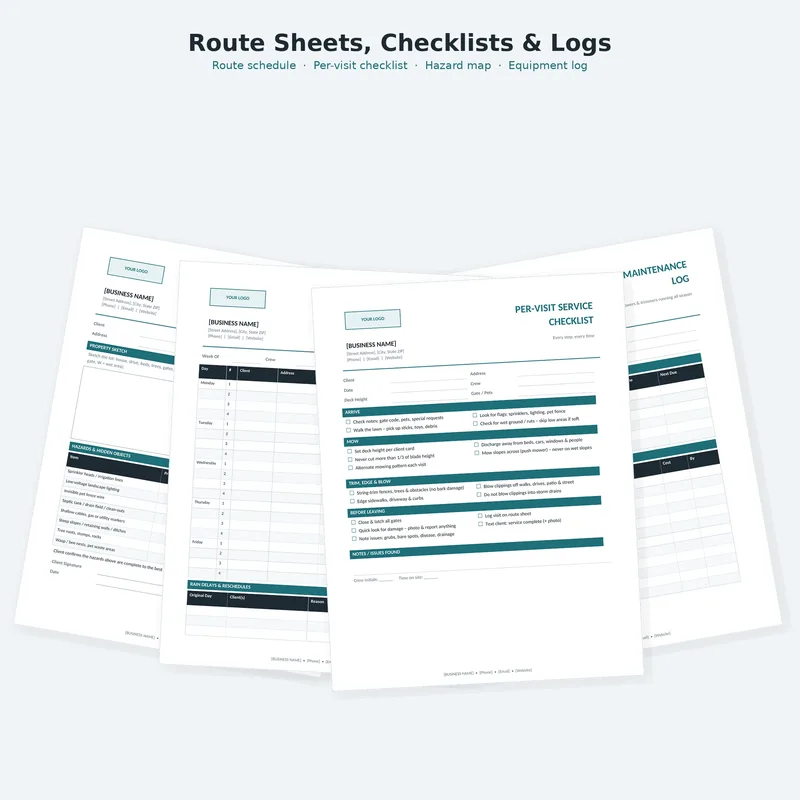
- Recurring route schedule: a weekly route sheet to plan stops and track visits.
- Per-visit service checklist so every stop gets the same mow, trim, edge and blow.
- Seasonal cleanup checklist for spring and fall cleanups.
- Equipment maintenance log to keep mowers and trimmers running all season.
Getting paid
- Invoice and a cancellation, weather and payment policy that says what happens on rain days and when payment is due, plus a feedback form.
Do you need a license or insurance for a lawn care business?
For basic mowing, many places only require a general business license or registration, but it varies by state, county and city. Check with your local offices, and use the SBA's Launch your business guide for an overview of registration, tax IDs and licenses.
Chemicals are different. The EPA's page on how to get certified as a pesticide applicator says federal law requires certification for anyone who applies or supervises the use of restricted use pesticides, that states, territories and tribes do the certifying, and that many states require all commercial applicators to be certified, not only those using restricted use pesticides. If you plan to offer weed control or similar treatments, contact your state's certifying agency before you do.
Some landscaping work, like hardscaping or irrigation, may fall under contractor licensing in some states. For insurance, talk to a licensed agent about general liability (mowers throw rocks) and about commercial auto if you haul a trailer.
Requirements vary by state, county and city. Check with your state and local licensing offices before you take paid jobs. This is general information, not legal or insurance advice.
How do you price lawn mowing and lawn care?
Most lawn care is priced per visit, with the lot size as the starting point. The kit's calculator works in this order:
- Lot size band. Small, medium or large lot, plus a charge for each extra 5,000 square feet on bigger properties.
- Service level multiplier. Mow, trim, edge and blow is the 1.0 baseline. Mow only is lower, full service with beds and shrubs is higher, and an overgrown first cut is higher still.
- Frequency adjustment. This works the opposite way from most trades. Weekly is the baseline, and bi-weekly or one-time and on-call visits get a surcharge because the grass is taller and the stop is harder to schedule. In the workbook a negative "discount" means a surcharge, and you can change the percentages.
- Add-ons such as bagging clippings, hand-weeding beds, light shrub trimming, edging bed lines, stick pickup, a light leaf blow-out, a one-story gutter clean or pet waste pickup.
- Mulch and materials at your cost plus a markup, if the job uses any.
- Minimum visit price so a tiny yard still covers the stop.
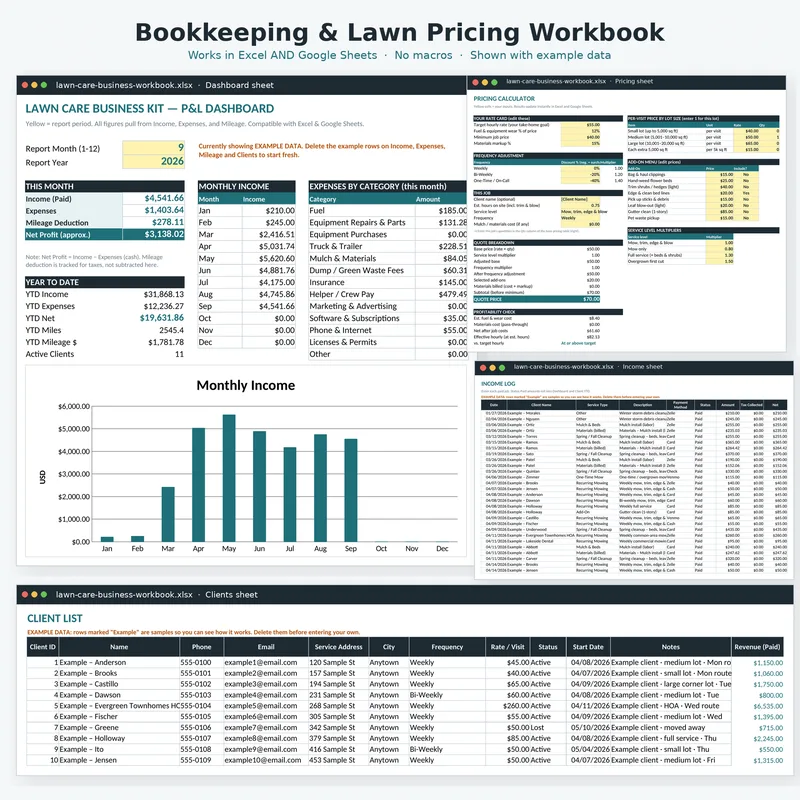
- Profitability check. The sheet subtracts a fuel and equipment wear percentage and any materials, divides by the hours on site, and compares the result to your target hourly rate.
Worked example: how the kit's calculator adds it up
Example numbers only. These are the placeholder rates that come pre-filled in the workbook so you can see how the math flows. They are not market prices or a recommendation. Replace them with rates based on your own costs and your local market.
| Medium lot (5,001–10,000 sq ft): 1 visit × $50.00 | $50.00 |
| Service level: Mow, trim, edge & blow (× 1.0) | $50.00 |
| Frequency: Weekly (no adjustment) | $50.00 |
| Add-on: Edge & clean bed lines ($20.00) | + $20.00 |
| Quote price (never below the $40.00 minimum) | $70.00 |
| Est. fuel & wear cost (12% of price) | − $8.40 |
| Net after job costs | $61.60 |
| ÷ 0.75 estimated hours on site | $82.13/hr |
| vs. example target of $55.00/hr | At or above target |
Lawn care margins depend on time on site and time between stops, so pair the calculator with the route schedule. A lawn that looks profitable on its own can lose money if it sits 20 minutes away from your other stops. Group clients by area and day when you can.
Set your own lot prices from your real costs (fuel, equipment, repairs, trailer, insurance, dump or green waste fees) and the hourly rate you need, then compare them with what local lawn services charge.
How do you track income, expenses and mileage for a lawn care business?
Lawn care costs pile up quietly: fuel every day, blades and belts, equipment repairs and green waste fees. Log every paid visit, every expense and every business trip each week. The workbook's income, expense and mileage tabs feed a monthly profit and loss dashboard, which matters in a seasonal business because you can see how much the busy months need to carry the slow ones.
Use the equipment maintenance log alongside your expense log so you know what each mower actually costs to keep running, and keep business spending on a separate account or card.
What should go in each log?
- Income log: one row per paid job: date, client, service type, payment method, status (paid or unpaid) and amount. In this kit the service types are pre-set to Recurring Mowing, Spring / Fall Cleanup, Mulch & Beds, Hedge & Shrub Trimming, Aeration & Overseeding, One-Time Mow, Materials (billed), Add-On and Other, so you can see which kind of work brings in the most.
- Expense log: date, vendor, category, amount, and whether you kept the receipt. The kit's categories are Fuel, Equipment Repairs & Parts, Equipment Purchases, Truck & Trailer, Mulch & Materials, Dump / Green Waste Fees, Insurance, Helper / Crew Pay, Marketing & Advertising, Software & Subscriptions, Phone & Internet, Licenses & Permits and Other.
- Mileage log: date, from, to, purpose and miles. The sheet multiplies miles by a rate you enter.
The IRS publishes a standard mileage rate and changes it from time to time. On its standard mileage rates page (checked October 2026), the business rate is 72.5 cents per mile for January 1 to June 30, 2026 and 76 cents per mile for July 1 to December 31, 2026. The workbook ships with an example rate, so type in the rate that applies to your trips. Whether you can use the standard rate at all depends on your situation, so ask a tax professional.
For what records to keep, the IRS page What kind of records should I keep says your books must show your gross income and your deductions, backed by documents like invoices, receipts and bank statements. Self-employed people generally file Schedule C and may need to pay estimated tax each quarter; see the IRS Self-Employed Individuals Tax Center. This is general information, not tax advice.
Step-by-step: how do you start a lawn care business?
- Decide what you'll offer: mowing only, mow-trim-edge-blow, full service, cleanups or a mix.
- Check business license and registration rules for your city, county and state.
- If you'll apply any pesticide or weed treatment, contact your state's pesticide certification agency first.
- Talk to a licensed insurance agent about general liability and commercial auto coverage.
- Open a separate business bank account or card.
- Set your lot size prices, service level multipliers, frequency adjustments, add-ons and minimum from your costs and target hourly rate.
- Fill in your seasonal agreement, damage waiver and cancellation, weather and payment policy, and have a local attorney review them.
- Brand your estimate, invoice and checklists, and set up the route schedule by area and day.
- Set up your income, expense, mileage and equipment logs, and delete the example data.
- On each new client: intake, a hazard walkaround, estimate, signed agreement, then add them to the route.
What's in the Lawn Care Business Kit?
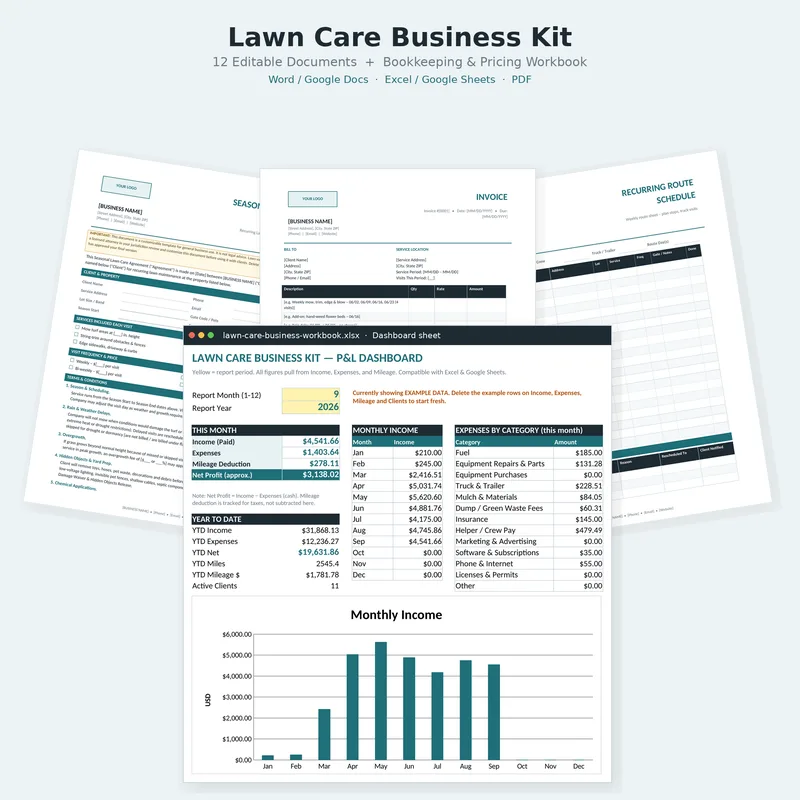
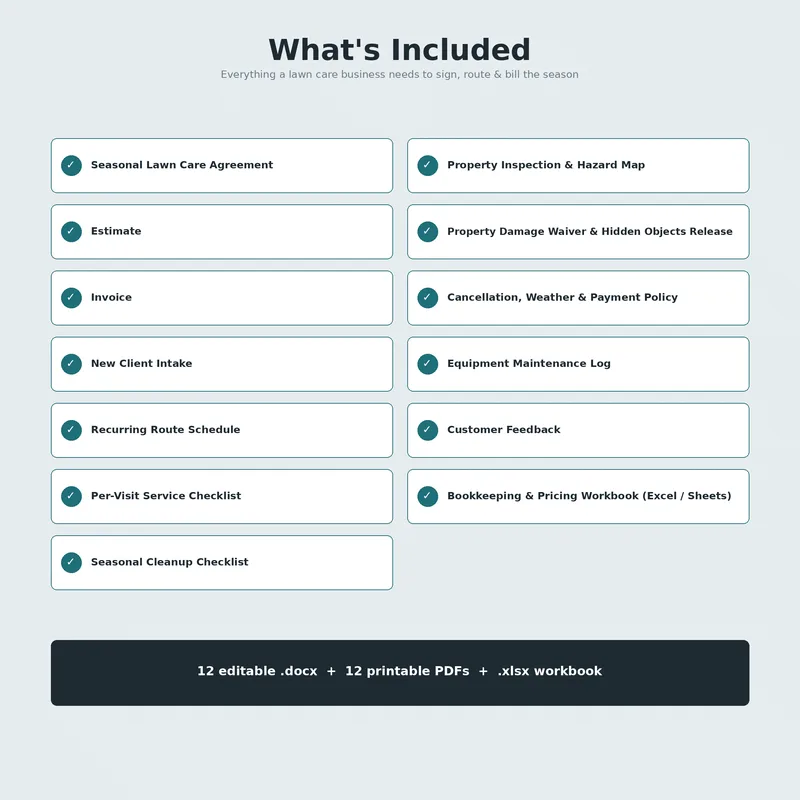
Everything a mowing or lawn care operator needs to sign up clients for the season, plan routes, mow safely and get paid: 12 editable documents plus a per-visit pricing and bookkeeping workbook for Excel and Google Sheets.
$19.99 · instant digital download · nothing is shipped
Same files on both stores. Pick whichever you already use.
Documents (12 editable Word files + matching PDFs)
- Seasonal Lawn Care Agreement – Recurring Lawn Maintenance Service Contract
- Estimate
- Invoice
- New Client Intake – Lawn & Property Information
- Recurring Route Schedule – Weekly route sheet – plan stops, track visits
- Per-Visit Service Checklist – Every stop, every time
- Seasonal Cleanup Checklist – Spring & fall cleanup tasks
- Property Inspection & Hazard Map – First-visit walkaround – mark hazards before mowing
- Property Damage Waiver & Hidden Objects Release – Lawn & Landscape Maintenance
- Cancellation, Weather & Payment Policy
- Equipment Maintenance Log – Keep mowers & trimmers running all season
- Customer Feedback
Bookkeeping and pricing workbook (.xlsx, Excel and Google Sheets)
- Pricing calculator: lot-size bands, service level, weekly / bi-weekly / one-time adjustment, add-ons, mulch markup, target hourly rate
- Income log, expense log and mileage log
- Client list with paid revenue per client
- Monthly profit and loss dashboard with a chart
- Comes filled with clearly labeled example data so you can see how it works (delete it before you start)
- Formulas use only functions that work in both Excel and Google Sheets. No macros.
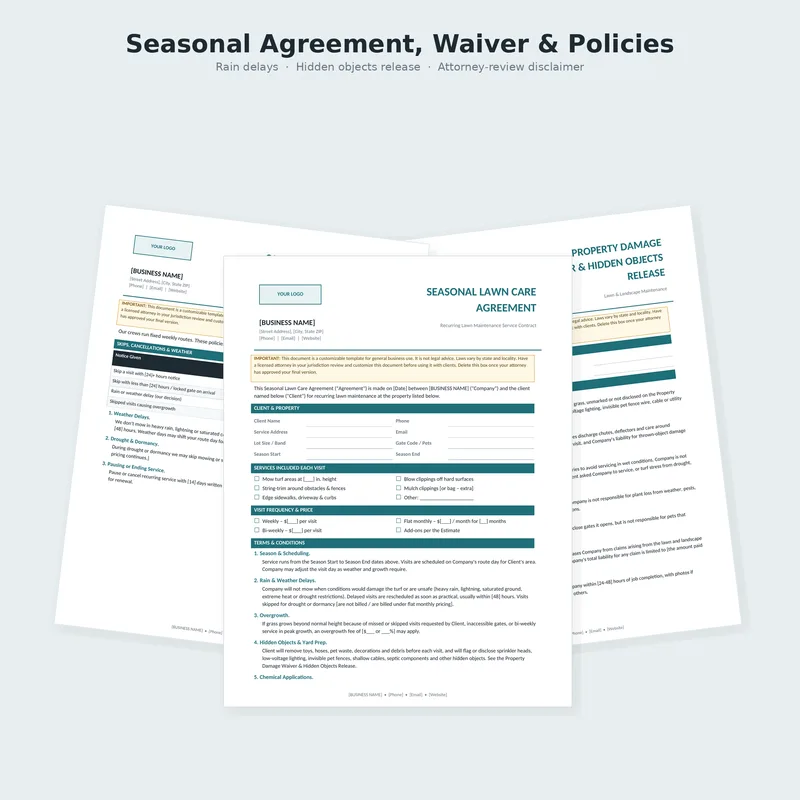
The legal documents are templates, not legal advice. Each one says so on the page. Have a licensed attorney in your state review them before you use them with clients.
Lawn Care business FAQ
What paperwork does a lawn care business need?
A seasonal service agreement, an estimate, an invoice, a client intake form, a route schedule, per-visit and seasonal cleanup checklists, a property inspection and hazard map, a damage waiver, a cancellation, weather and payment policy and an equipment maintenance log.
How do you price lawn mowing?
Start with the lot size, adjust for the service level (mow only up to full service) and the frequency, add any extras, and keep a minimum per visit. Then check that the price still pays your target hourly rate after fuel and equipment wear.
Should bi-weekly mowing cost more per visit than weekly?
That's your call. Grass that's had two weeks to grow usually takes longer to cut, so the kit's calculator treats weekly as the baseline and lets you set a surcharge for bi-weekly and one-time visits. Set it to zero if you'd rather charge the same.
Do I need a license to mow lawns?
It depends on your state and city. Basic mowing often needs only a general business license or registration, but check with your local offices. Applying pesticides is regulated separately and can require state certification.
Do I need a license to spray weeds or fertilize?
Pesticide use is regulated. Federal law requires certification for restricted use pesticides, and the EPA notes many states require all commercial applicators to be certified. Fertilizer rules vary by state. Contact your state's agency before offering treatments.
What should a lawn care contract include?
The services and service level, the season and visit frequency, the price per visit and billing schedule, what happens on rain days, how to cancel, and limits of responsibility for hidden objects. Have a local attorney review the final version.
How do I track lawn care business expenses?
Log fuel, repairs and parts, equipment purchases, truck and trailer costs, mulch and materials, and dump or green waste fees with the date and receipt. A separate business card makes this much easier.
Does the workbook work in Google Sheets?
Yes. It's an .xlsx file that uses only functions supported in both Excel and Google Sheets, with no macros.