How to Start a House Cleaning Business: The Paperwork, Pricing and Bookkeeping You Need
Short answer: To start a house cleaning business, you need a written service agreement, an estimate and invoice, cleaning checklists, a cancellation and payment policy, and a simple way to track money and miles. Price each job from the home's size, the type of clean and how often you'll come, then check that the price still pays you a fair hourly rate after supplies. Licensing, insurance and tax rules depend on your state and city, so check with your local offices before your first paid clean.
What paperwork do you need to start a house cleaning business?
At minimum you want paperwork for four moments: before the first visit, agreeing on the job, doing the work, and getting paid.
Before the first clean
- New client intake form: address, home size, pets, entry instructions, priorities and anything off-limits.
- Walkthrough and inspection sheet: note the home's condition before you start and do a quality check after. This helps if a client later says something was damaged or missed.
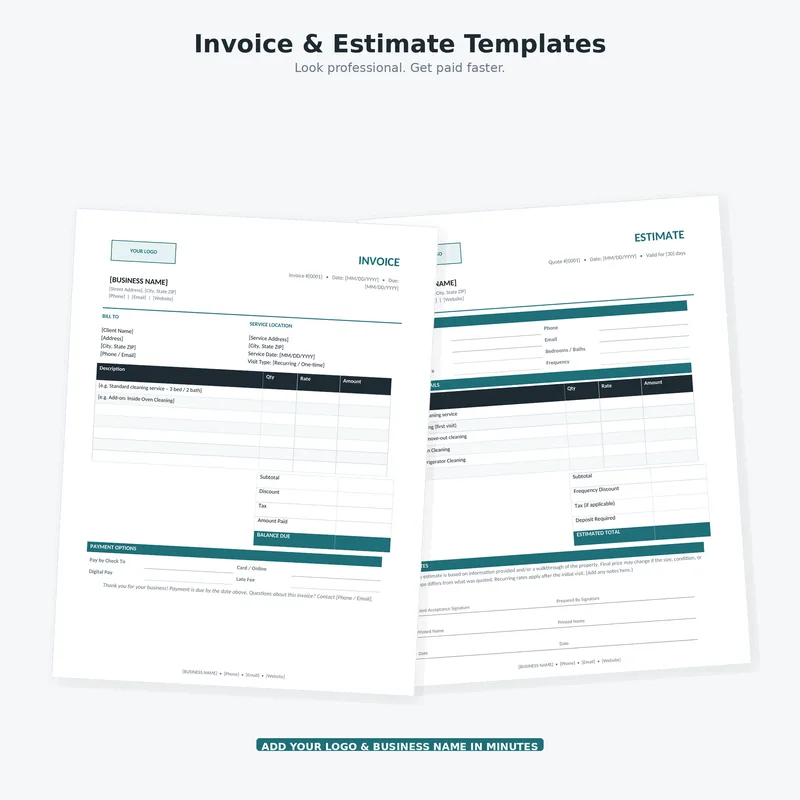
- Estimate: the price, what's included, the frequency and how long the quote is good for.
Agreeing on the job
- Service agreement (cleaning contract): the scope of work, schedule, price, payment terms and what happens if either side wants to stop.
- Key and access agreement: if clients give you a key, garage code or alarm code, put in writing how you store it and who is responsible.
- Cancellation and payment policy: late cancellations, lockouts, late payments and accepted payment methods. Clients take a written policy more seriously than a text message.
Doing the work and getting paid
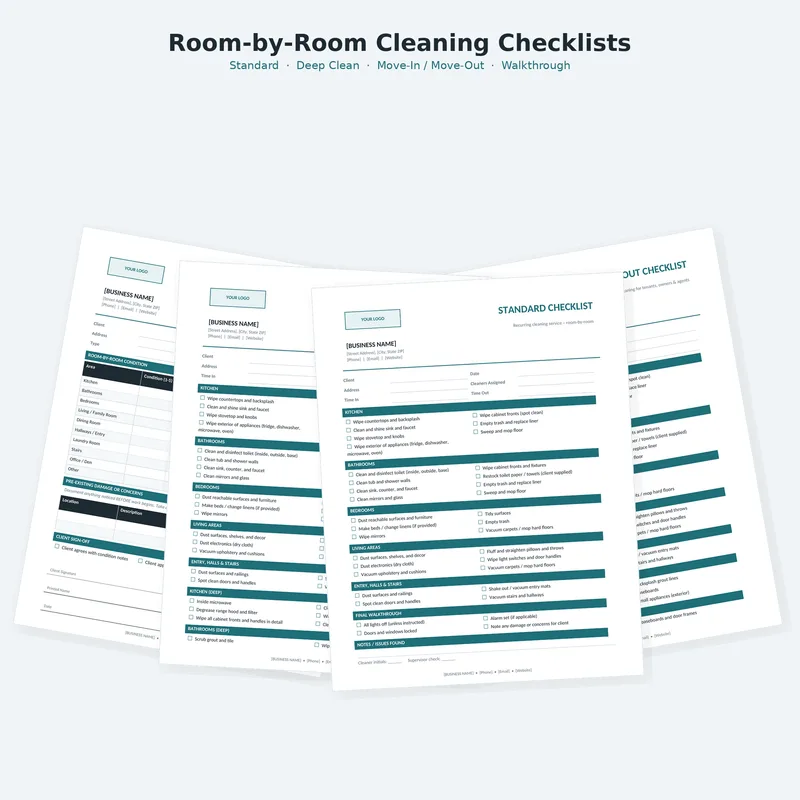
- Checklists for a standard clean, a deep clean and a move-in or move-out clean, so every visit covers the same tasks, especially once you add a helper.
- Invoice with your business name, the service date, line items and the due date.
- Feedback form to catch problems early and ask happy clients for referrals.
Do you need a license or insurance to start a cleaning business?
It depends on where you live. Many places require some kind of general business license or registration even for a one-person cleaning business, and some cities have their own home-business or occupational rules. If you use a business name that isn't your own legal name, you may also need to register it (often called a DBA).
The U.S. Small Business Administration's Launch your business guide explains business structures, name registration, tax ID numbers and state and local licenses, and says requirements vary by business activity and location. It's a good place to start before calling your city or county.
Insurance isn't the same as a license. Because you work inside people's homes, talk to a licensed insurance agent about general liability coverage. If you hire employees, the SBA notes that workers' compensation, unemployment and disability insurance come into play. Some cleaners also look into bonding because clients ask about it. Ask an agent what makes sense for you.
Requirements vary by state, county and city. Check with your state and local licensing offices before you take paid jobs. This is general information, not legal or insurance advice.
How do you price house cleaning jobs?
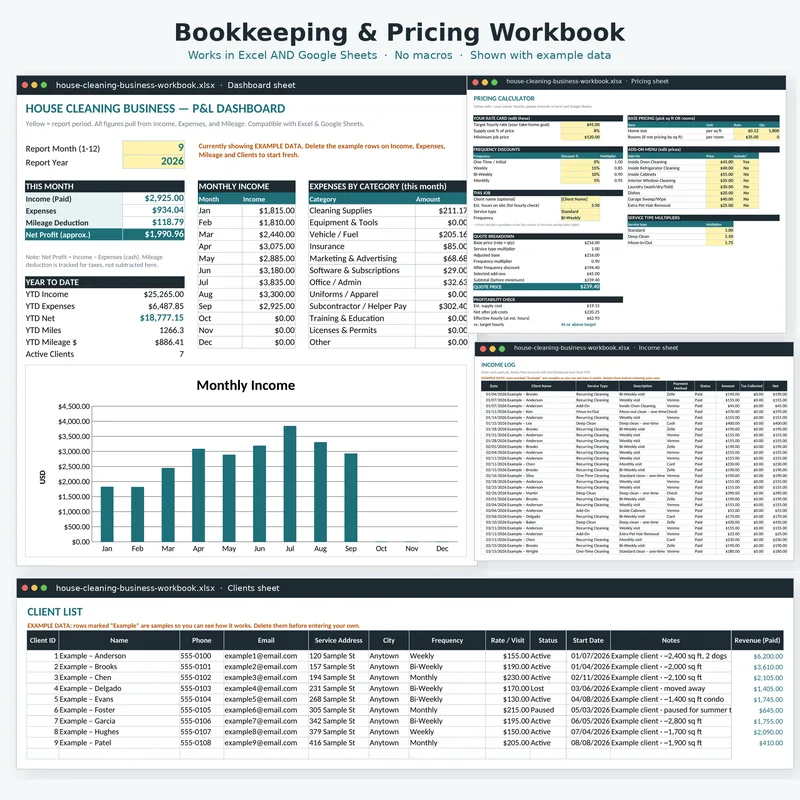
Most cleaners price per visit, not strictly by the hour, but they check the price against an hourly goal. The kit's calculator works in this order:
- Base price from the home's size. Square feet × your rate per square foot, or number of rooms × your rate per room if you'd rather count rooms.
- Service type multiplier. A standard clean is 1.0. Deep cleans and move-in or move-out cleans take longer, so the workbook multiplies the base (its example values are 1.5 and 1.75).
- Frequency discount. Recurring clients often get a lower per-visit price because the home stays cleaner between visits. The example discounts are 15% weekly, 10% bi-weekly and 5% monthly, and you can change them.
- Add-ons. Extras like inside the oven or fridge, inside cabinets, interior windows, laundry or extra pet hair, each with its own price.
- Minimum job price. The quote never goes below your minimum, so small jobs are still worth the drive.
- Profitability check. The sheet subtracts an estimated supply cost (a percentage of the price), divides by the hours you expect to be on site, and tells you whether you're at or below your target hourly rate.
Worked example: how the kit's calculator adds it up
Example numbers only. These are the placeholder rates that come pre-filled in the workbook so you can see how the math flows. They are not market prices or a recommendation. Replace them with rates based on your own costs and your local market.
| Home size: 1,800 sq ft × $0.12 | $216.00 |
| Service type: Standard (× 1.0) | $216.00 |
| Frequency: Bi-Weekly (10% off) | $194.40 |
| Add-on: Inside Oven Cleaning ($45.00) | + $45.00 |
| Quote price (never below the $120.00 minimum) | $239.40 |
| Est. supply cost (8% of price) | − $19.15 |
| Net after job costs | $220.25 |
| ÷ 3.5 estimated hours on site | $62.93/hr |
| vs. example target of $45.00/hr | At or above target |
The useful part is the last line. If the effective hourly rate comes out below your target, either the price is too low or the job will take longer than you think. Raise the rate, add an add-on or rethink the frequency discount before you send the estimate.
Set your own rates by adding up your real costs (supplies, fuel, insurance, phone, software) and the hourly pay you need. Then look at what local cleaning services publish. Don't copy a number off the internet. Prices vary a lot from one area to another.
How do you track income, expenses and mileage for a house cleaning business?
Keep it simple and do it every week: log every paid job, every business expense and every business trip in one place. The kit's workbook has separate income, expense and mileage tabs that roll up into a monthly profit and loss dashboard, so you can see income, expenses, mileage and approximate net profit for any month and the year to date.
A business bank account or card used only for the business makes this much easier, because your statement becomes a checklist of what to log. Snap a photo of every receipt on the day you get it.
What should go in each log?
- Income log: one row per paid job: date, client, service type, payment method, status (paid or unpaid) and amount. In this kit the service types are pre-set to Recurring Cleaning, One-Time Cleaning, Deep Clean, Move-In/Out, Add-On, Tip and Other, so you can see which kind of work brings in the most.
- Expense log: date, vendor, category, amount, and whether you kept the receipt. The kit's categories are Cleaning Supplies, Equipment & Tools, Vehicle / Fuel, Insurance, Marketing & Advertising, Software & Subscriptions, Office / Admin, Uniforms / Apparel, Subcontractor / Helper Pay, Training & Education, Licenses & Permits and Other.
- Mileage log: date, from, to, purpose and miles. The sheet multiplies miles by a rate you enter.
The IRS publishes a standard mileage rate and changes it from time to time. On its standard mileage rates page (checked October 2026), the business rate is 72.5 cents per mile for January 1 to June 30, 2026 and 76 cents per mile for July 1 to December 31, 2026. The workbook ships with an example rate, so type in the rate that applies to your trips. Whether you can use the standard rate at all depends on your situation, so ask a tax professional.
For what records to keep, the IRS page What kind of records should I keep says your books must show your gross income and your deductions, backed by documents like invoices, receipts and bank statements. Self-employed people generally file Schedule C and may need to pay estimated tax each quarter; see the IRS Self-Employed Individuals Tax Center. This is general information, not tax advice.
Step-by-step: how do you start a house cleaning business?
- Decide what you'll offer first: recurring standard cleans, deep cleans, move-in and move-out cleans, or a mix.
- Pick a business name and check whether you need to register it in your state or county.
- Look up business license and registration rules for your city, county and state, using the SBA guide as a starting point.
- Talk to a licensed insurance agent about liability coverage, and about bonding if clients in your area ask for it.
- Open a separate bank account (or at least a separate card) for business money.
- Work out your costs and target hourly rate, then set your per-square-foot or per-room rates, multipliers, discounts and add-on prices.
- Fill in your service agreement, cancellation policy and key access agreement, and have a local attorney review them.
- Brand your estimate, invoice and checklists with your name, logo and contact details.
- Set up your income, expense and mileage logs and delete any example data.
- Do a walkthrough, send the estimate and get the agreement signed before the first clean.
What's in the House Cleaning Business Kit?
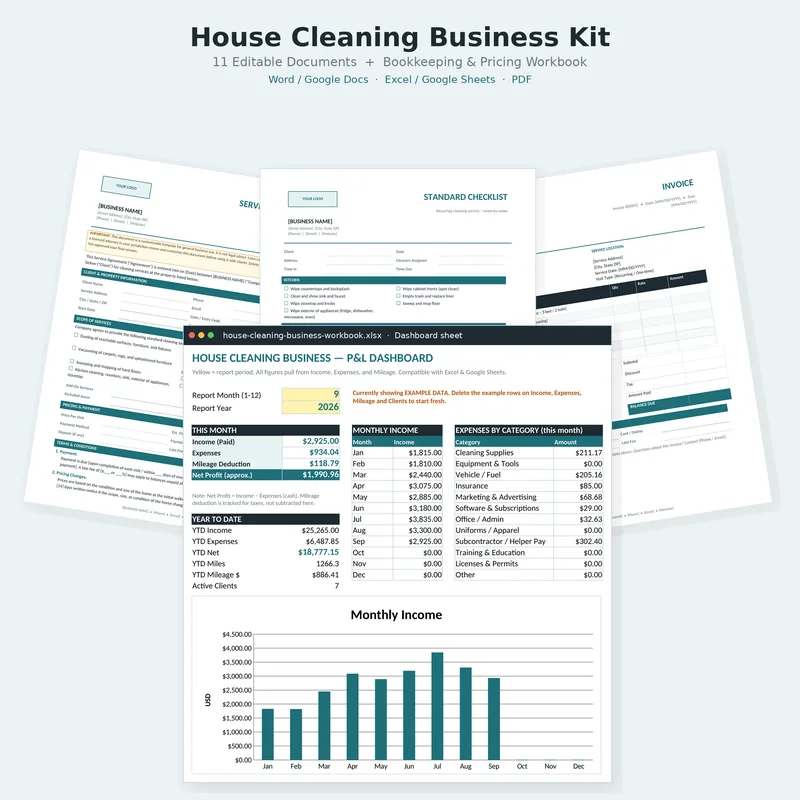
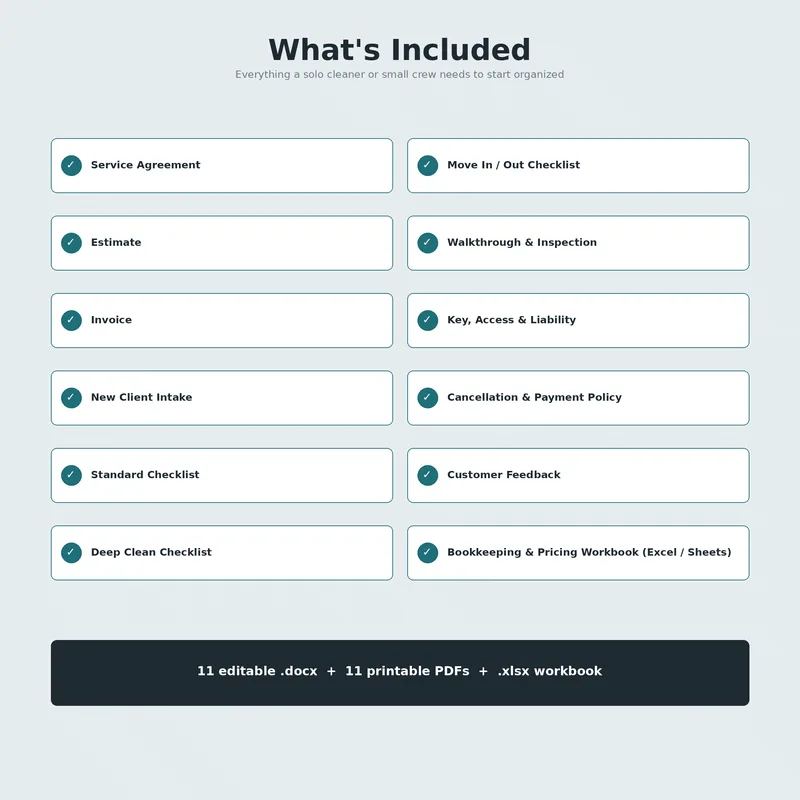
Everything a solo cleaner or small crew needs to quote, contract, clean and get paid, in one matching set: 11 editable documents plus a bookkeeping and pricing workbook for Excel and Google Sheets.
$19.99 · instant digital download · nothing is shipped
Same files on both stores. Pick whichever you already use.
Documents (11 editable Word files + matching PDFs)
- Service Agreement
- Estimate
- Invoice
- New Client Intake
- Standard Checklist – Recurring cleaning service – room-by-room
- Deep Clean Checklist – Standard tasks + detailed deep cleaning
- Move In / Out Checklist – Empty-home cleaning for tenants, owners & agents
- Walkthrough & Inspection – Pre-service assessment & post-service quality check
- Key, Access & Liability – Property Access Agreement and Release
- Cancellation & Payment Policy
- Customer Feedback
Bookkeeping and pricing workbook (.xlsx, Excel and Google Sheets)
- Pricing calculator: sq ft or rooms, service type, frequency discounts, add-ons, target hourly rate, supply cost
- Income log, expense log and mileage log
- Client list with paid revenue per client
- Monthly profit and loss dashboard with a chart
- Comes filled with clearly labeled example data so you can see how it works (delete it before you start)
- Formulas use only functions that work in both Excel and Google Sheets. No macros.
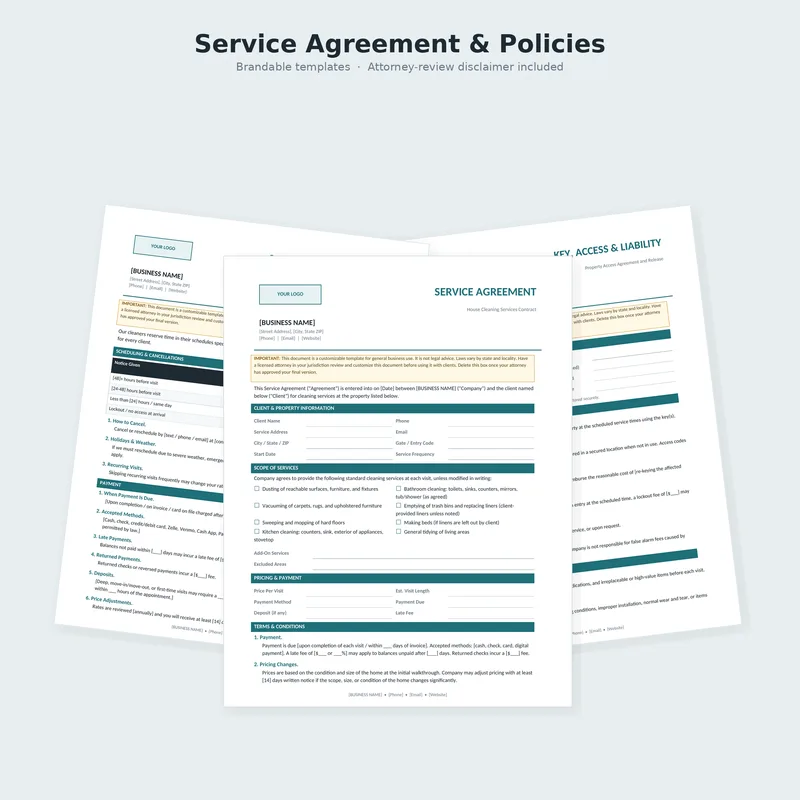
The legal documents are templates, not legal advice. Each one says so on the page. Have a licensed attorney in your state review them before you use them with clients.
House Cleaning business FAQ
What paperwork does a cleaning business need?
The core set is a service agreement, an estimate, an invoice, a new client intake form, cleaning checklists, a cancellation and payment policy, and a key or access agreement if you hold keys or codes. A walkthrough sheet and a feedback form are useful extras.
Do I need a contract for house cleaning clients?
No law makes every cleaner use one, but a written agreement makes the scope, price, schedule and cancellation terms clear and gives you something to point to if there's a dispute. Contract rules vary by state, so have a local attorney review yours.
How do I figure out what to charge for cleaning?
Start from the home's size (square feet or rooms), adjust for the type of clean and how often you come, add any extras, and make sure the price never drops below your minimum. Then divide what's left after supplies by the hours on site and compare it to the hourly rate you need.
Should I charge by the hour or by the job?
Many cleaners quote a flat price per visit because clients like knowing the cost up front. Tracking your hours still matters, because that's how you find out if a flat price is actually paying you. The kit's calculator does both: a flat quote plus an hourly check.
Do I need a license to clean houses?
It depends on your state, county and city. Many places require a general business license or registration, and some have extra local rules. Check with your local licensing office. The SBA's Launch your business guide explains where to look.
Do I need insurance for a cleaning business?
It isn't always legally required for a solo owner, but you'll be working in clients' homes, so talk with a licensed insurance agent about general liability coverage. If you hire employees, other insurance rules generally apply, and those vary by state.
How do I keep track of cleaning business expenses?
Log every purchase with the date, vendor, category, amount and whether you kept the receipt. Use a separate business account so nothing slips through. The kit's expense log uses cleaning-specific categories like cleaning supplies, equipment and vehicle or fuel.
Does the spreadsheet work in Google Sheets?
Yes. The workbook is an .xlsx file that uses only functions supported in both Excel and Google Sheets, with no macros. Upload it to Google Drive and open it with Google Sheets.