How to Start a Handyman Business: The Paperwork, Pricing and Bookkeeping You Need
Short answer: To start a handyman business, you need a services agreement, an estimate, a work order that spells out the scope, a change order for when the job grows, and an invoice, plus a way to track labor, materials and mileage. Price jobs from your labor rate, flat-rate tasks, a trip charge and marked-up materials, then check the result against your target hourly rate. What a handyman is allowed to do without a contractor or trade license depends on your state and city, so check that first.
What paperwork do you need to start a handyman business?
Handyman jobs tend to grow once you open a wall or look behind the fixture. Good paperwork keeps the scope, price and surprises in writing.
Quoting and agreeing on the job
- New client intake: home details, contact info, access and the list of what they want done.
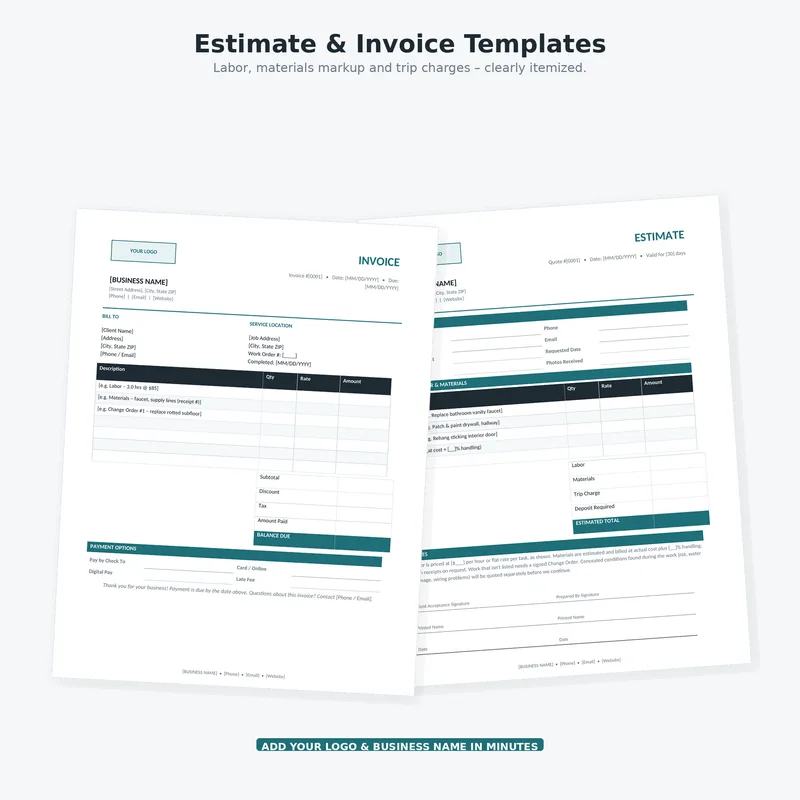
- Estimate: labor, materials, trip charge and how long the quote is good for.
- Handyman services agreement: scope, pricing, payment, schedule, who supplies materials, and limits on the work you do.
- Job scope and work order: exactly what you're doing, with what materials, and when.
When the job changes
- Change order: any change to scope, materials, price or schedule, signed before you do the extra work. This is the form that prevents most "I didn't agree to that" arguments.
- Property damage and hidden conditions waiver: covers what you couldn't see before you started, like rot behind tile or old wiring behind a fixture.
- Materials list and purchase log: plan, buy, mark up and bill materials accurately.
Finishing and getting paid
- Job site safety and completion checklist for before, during and after every job.
- Punch list and final walkthrough so the job closes out cleanly.
- Invoice, plus a cancellation, payment and warranty policy stating what you stand behind and for how long. Add a feedback form for referrals.
Do you need a license to be a handyman?
This is the most important question to answer before you take jobs, and the answer depends on your state and sometimes your city. Many states require a contractor license once a job goes above a certain size or cost, and electrical, plumbing, gas and HVAC work commonly require a separately licensed tradesperson no matter how small the job is. Some places also require registration or a general business license for any handyman work.
Look up your state contractor licensing board and your city's rules, and stay inside what you're allowed to do. That's why the kit's example add-on menu sticks to work like TV mounting with no in-wall wiring and like-for-like fixture swaps. Check whether even those are allowed where you work. The SBA's Launch your business guide covers business registration, tax IDs and state and local licenses in general.
Some jobs also need permits. Ask your local building department when a permit is required. For insurance, talk to a licensed agent about general liability coverage, and about workers' compensation if you hire employees.
Requirements vary by state, county and city. Check with your state and local licensing offices before you take paid jobs. This is general information, not legal or insurance advice.
How do you price handyman jobs?
Handyman pricing usually mixes hourly labor and flat-rate tasks, plus materials. The kit's calculator works in this order:
- Labor and service lines. Hours × your labor rate, plus any flat-rate small tasks, a trip or service charge, and helper hours if you bring someone.
- Scheduling multiplier. Standard weekday work is 1.0. Rush or next-day work and after-hours or weekend work get a higher multiplier, and you can give property managers a lower one.
- Maintenance plan discount for clients on a monthly or quarterly plan.
- Flat-rate add-ons from a menu you control, such as TV mounting with no in-wall wiring, re-caulking a tub, smoke or CO detector swaps, like-for-like light fixture swaps, door adjustments, furniture assembly, small debris haul-away and small drywall patches.
- Materials at cost plus markup. Enter what you paid and your markup percentage. The markup covers your time shopping, picking up and handling returns.
- Minimum job price so a quick fix still covers the drive.
- Profitability check. The sheet subtracts consumables (a percentage of the price) and the materials you paid for, divides by your hours on site and compares the result to your target hourly rate.
Worked example: how the kit's calculator adds it up
Example numbers only. These are the placeholder rates that come pre-filled in the workbook so you can see how the math flows. They are not market prices or a recommendation. Replace them with rates based on your own costs and your local market.
| Labor: 3 hours × $85.00 | $255.00 |
| Flat-rate small task: 1 task × $45.00 | $45.00 |
| Trip / service charge: 1 visit × $45.00 | $45.00 |
| Scheduling / rate type: Standard (weekday) (× 1.0) | $345.00 |
| Frequency: One-Time / Per Job (no adjustment) | $345.00 |
| Add-on: Smoke / CO detector swap (each) ($25.00) | + $25.00 |
| Materials: $120.00 cost + 20% markup | + $144.00 |
| Quote price (never below the $125.00 minimum) | $514.00 |
| Est. consumables cost (3% of price) | − $15.42 |
| Materials you paid for | − $120.00 |
| Net after job costs | $378.58 |
| ÷ 3.5 estimated hours on site | $108.17/hr |
| vs. example target of $65.00/hr | At or above target |
Two habits protect your margin: always add a trip charge or minimum, and always put materials on the invoice at cost plus markup instead of hiding them in the labor. Then, when a client asks to add "one more thing," write a change order and run it through the calculator again.
Set your labor rate from your actual costs (tools, vehicle, insurance, phone, unpaid drive and estimate time) and the income you need, then compare it with local handyman rates. Don't use the example numbers above as a price list.
How do you track income, expenses and mileage for a handyman business?
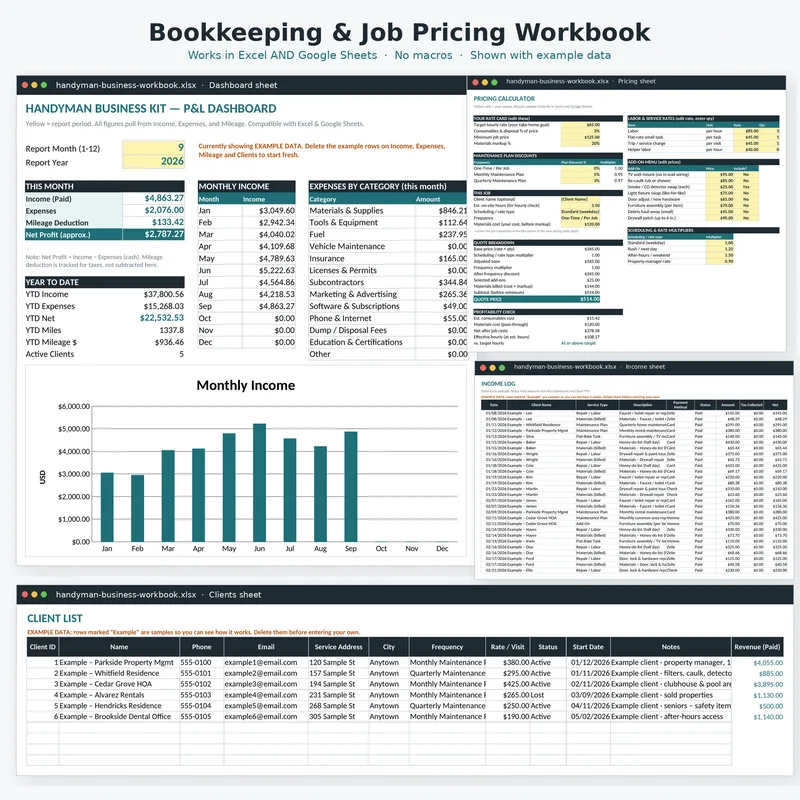
Handyman bookkeeping is mostly about not losing track of materials. Log every paid job, every receipt and every business trip in the same week it happens. The kit's workbook rolls income, expenses and mileage into a monthly profit and loss dashboard, and the separate materials list and purchase log helps you match each supply-house receipt to the job you billed it to.
Keep business purchases on a separate business card or account. If you buy materials for a client, write the job name on the receipt before it goes in the pile.
What should go in each log?
- Income log: one row per paid job: date, client, service type, payment method, status (paid or unpaid) and amount. In this kit the service types are pre-set to Repair / Labor, Flat-Rate Task, Maintenance Plan, Materials (billed), Trip Charge, Add-On and Other, so you can see which kind of work brings in the most.
- Expense log: date, vendor, category, amount, and whether you kept the receipt. The kit's categories are Materials & Supplies, Tools & Equipment, Fuel, Vehicle Maintenance, Insurance, Licenses & Permits, Subcontractors, Marketing & Advertising, Software & Subscriptions, Phone & Internet, Dump / Disposal Fees, Education & Certifications and Other.
- Mileage log: date, from, to, purpose and miles. The sheet multiplies miles by a rate you enter.
The IRS publishes a standard mileage rate and changes it from time to time. On its standard mileage rates page (checked October 2026), the business rate is 72.5 cents per mile for January 1 to June 30, 2026 and 76 cents per mile for July 1 to December 31, 2026. The workbook ships with an example rate, so type in the rate that applies to your trips. Whether you can use the standard rate at all depends on your situation, so ask a tax professional.
For what records to keep, the IRS page What kind of records should I keep says your books must show your gross income and your deductions, backed by documents like invoices, receipts and bank statements. Self-employed people generally file Schedule C and may need to pay estimated tax each quarter; see the IRS Self-Employed Individuals Tax Center. This is general information, not tax advice.
Step-by-step: how do you start a handyman business?
- Look up what handyman work is allowed in your state and city without a contractor or trade license, and write down the jobs you will and won't take.
- Register your business name if needed and get any required business license.
- Talk to a licensed insurance agent about general liability coverage.
- Open a separate business bank account or card.
- Set your labor rate, flat-rate task prices, trip charge, materials markup and minimum from your real costs.
- Fill in your services agreement, damage and hidden conditions waiver, and cancellation, payment and warranty policy, and have a local attorney review them.
- Brand your estimate, work order, change order, invoice and checklists.
- Set up your income, expense and mileage logs and your materials log, and delete the example data.
- On every job: intake, estimate, signed agreement and work order, then a change order for anything new, then a punch list and invoice.
- Ask satisfied clients for feedback and referrals, and offer a maintenance plan to repeat clients.
What's in the Handyman Business Kit?
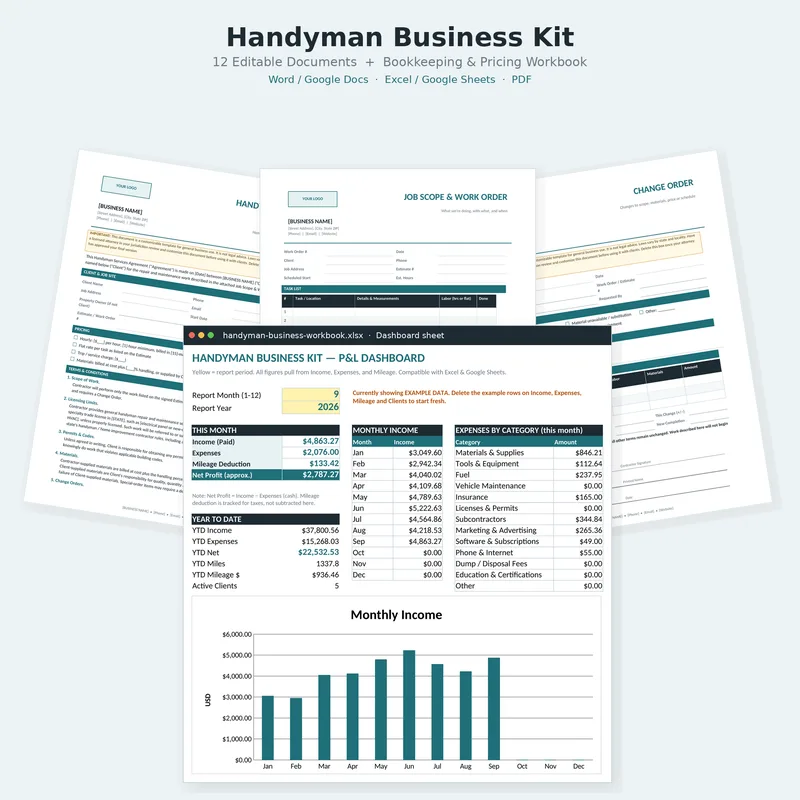
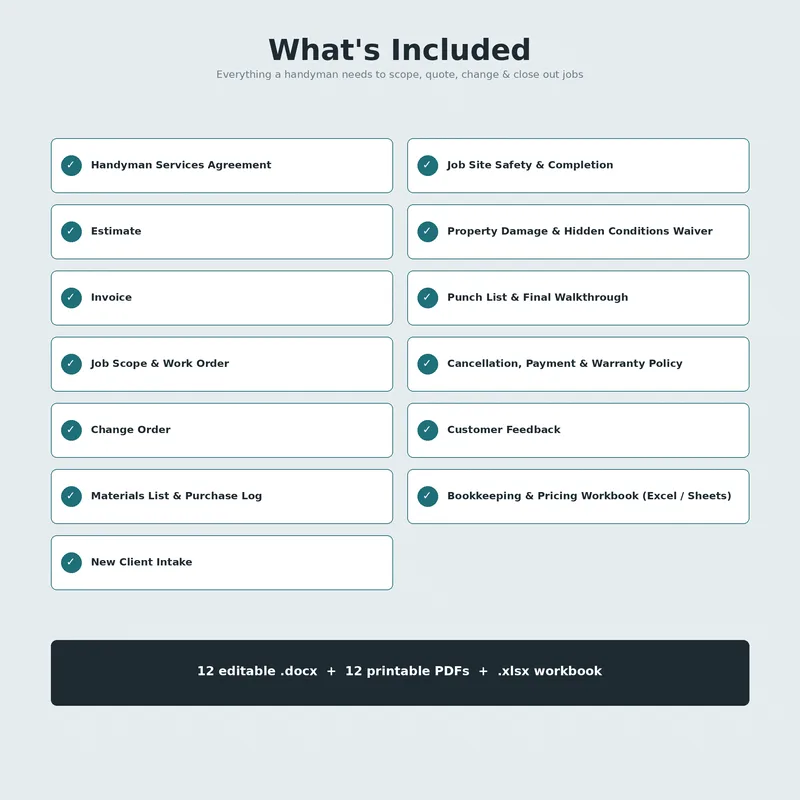
Everything a handyman needs to scope, quote, handle change orders, finish cleanly and get paid: 12 editable documents plus a job pricing and bookkeeping workbook for Excel and Google Sheets.
$19.99 · instant digital download · nothing is shipped
Same files on both stores. Pick whichever you already use.
Documents (12 editable Word files + matching PDFs)
- Handyman Services Agreement – Home Repair & Maintenance Contract
- Estimate
- Invoice
- Job Scope & Work Order – What we're doing, with what, and when
- Change Order – Changes to scope, materials, price or schedule
- Materials List & Purchase Log – Plan, buy, mark up and bill materials accurately
- New Client Intake – Home & Job Information
- Job Site Safety & Completion – Run before, during and after every job
- Property Damage & Hidden Conditions Waiver – Acknowledgment of Risks in Repair Work
- Punch List & Final Walkthrough – Close out every job cleanly
- Cancellation, Payment & Warranty Policy
- Customer Feedback
Bookkeeping and pricing workbook (.xlsx, Excel and Google Sheets)
- Pricing calculator: hourly and flat-rate labor, trip charge, materials cost + markup %, rush / after-hours multipliers, add-ons, target hourly rate
- Income log, expense log and mileage log
- Client list with paid revenue per client
- Monthly profit and loss dashboard with a chart
- Comes filled with clearly labeled example data so you can see how it works (delete it before you start)
- Formulas use only functions that work in both Excel and Google Sheets. No macros.
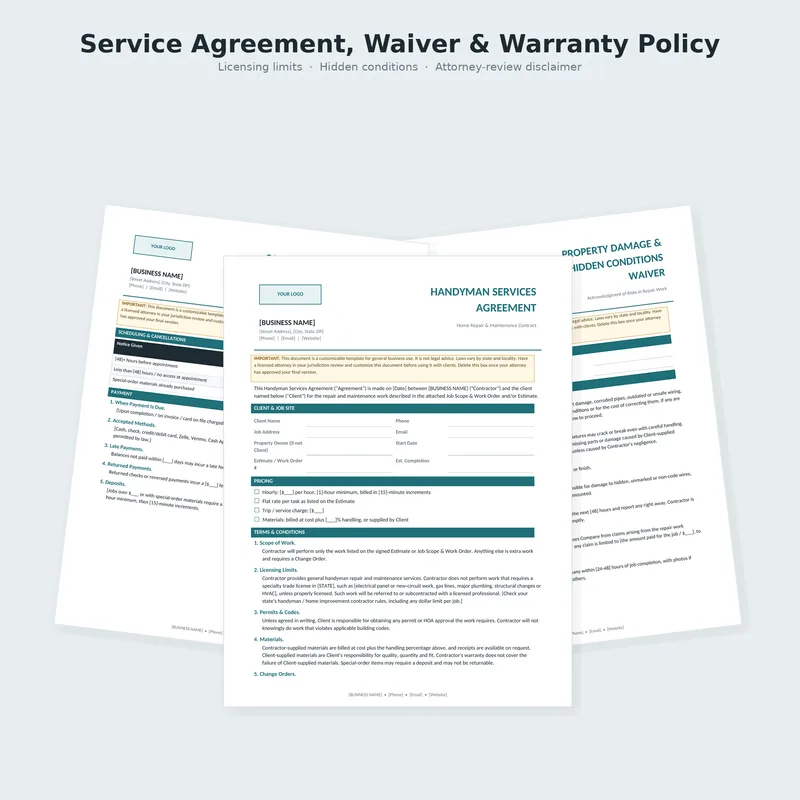
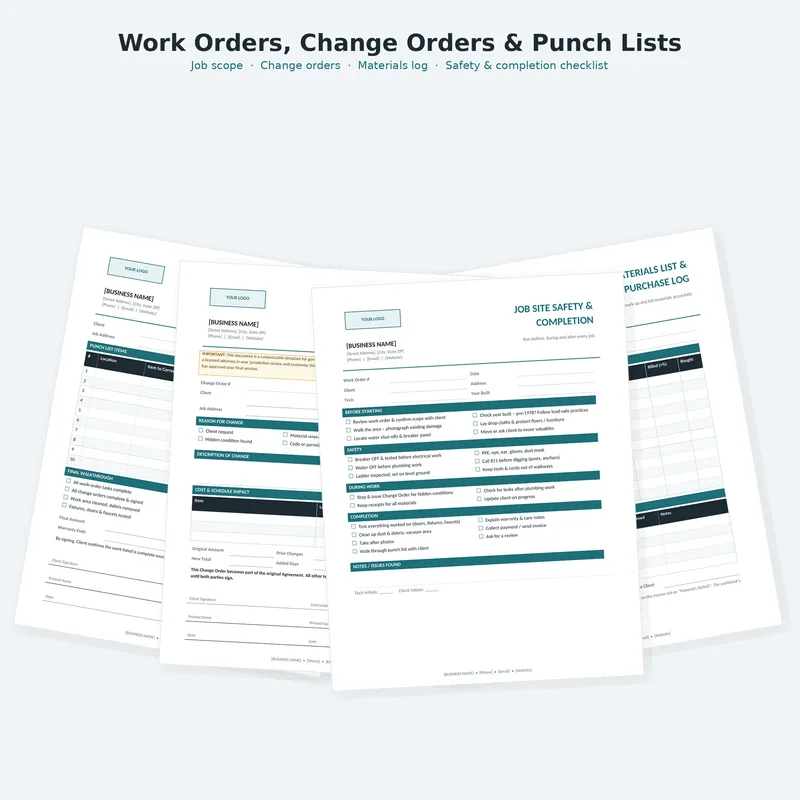
The legal documents are templates, not legal advice. Each one says so on the page. Have a licensed attorney in your state review them before you use them with clients.
Handyman business FAQ
What paperwork does a handyman business need?
A services agreement, an estimate, a work order, a change order, an invoice, a client intake form, a materials log, a damage and hidden conditions waiver, a punch list and a cancellation, payment and warranty policy.
What can a handyman legally do without a license?
It depends on your state and city. Many states require a contractor license above a certain job size or cost, and electrical, plumbing, gas and HVAC work commonly need a licensed tradesperson. Check with your state contractor licensing board and local building department.
How much should a handyman charge per hour?
There isn't one right number. It depends on your costs, your skills and your local market. Add up your business costs and the income you need, turn that into an hourly rate, then compare it with local handyman rates. The kit's calculator then checks every quote against that target.
Should a handyman charge for materials separately?
Usually, yes. Listing materials at cost plus a markup keeps your labor rate honest and covers your time buying and picking up supplies. Keep the receipts as proof.
What is a change order and why do I need one?
A change order is a short signed form that records a change to the scope, materials, price or schedule after the job is agreed. It protects both sides when the job grows.
Do I need insurance as a handyman?
Talk to a licensed insurance agent. Handymen commonly carry general liability insurance, and some states or clients require it. If you hire employees, workers' compensation rules generally apply.
Should I offer a warranty on my work?
Many handymen offer a limited workmanship warranty to build trust. Put the terms in writing, including what's covered, for how long and what's excluded, and have an attorney review the wording.
Does the workbook work in Google Sheets?
Yes. It's an .xlsx file that uses only functions supported in both Excel and Google Sheets, with no macros.