How to Start a Junk Removal Business: The Paperwork, Pricing and Bookkeeping You Need
Short answer: To start a junk removal business, you need a hauling agreement, a load-based estimate and invoice, a prohibited items list, a property damage waiver and a log of every load and dump fee. Most haulers price by how much of the truck a job fills, then adjust for stairs, heavy debris or rush jobs and add fees for items that cost extra to dispose of. Business licensing, vehicle, insurance and disposal rules vary by state and city, so check locally before you start.
What paperwork do you need to start a junk removal business?
Junk removal paperwork has one big job: make it clear what you're taking, what it costs, and who's responsible if something gets scuffed on the way out.
Booking and quoting
- Job booking and intake form: contact details, address, what's going, where it is (curb, garage, basement, upstairs) and access notes.
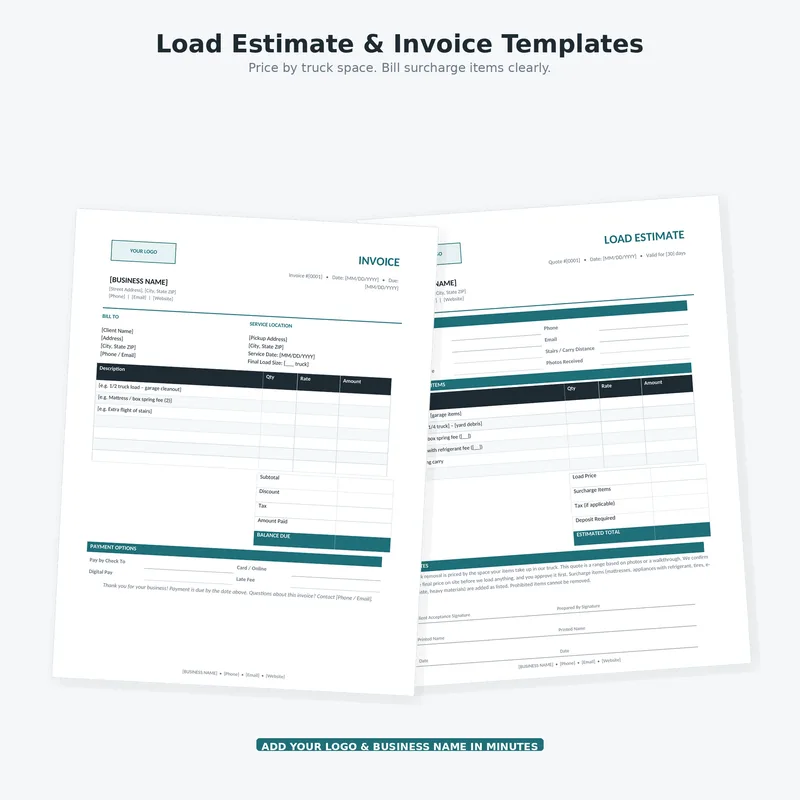
- Load estimate: the estimated load size and price, plus a note that the final price depends on the actual volume once it's on the truck.
- Load size pricing guide: a simple customer-facing sheet that shows your price by truck space so people know what to expect.
Before you lift anything
- Hauling and disposal agreement: scope, pricing, payment, what happens to items (landfill, recycling, donation) and limits of responsibility.
- Prohibited items list: what you can't take and what costs extra. Hazardous materials and appliances with refrigerant are common examples.
- Property damage and liability waiver: covers the removal path, driveways and existing damage.
- Pre-job walkthrough: record the condition of floors, walls and driveways before you load.
On the job and after
- Job site checklist for the crew before, during and after each load.
- Load and disposal log to record every load, dump fee and donation drop-off.
- Post-job walkthrough sign-off, invoice and cancellation and payment policy, plus a feedback form.
Do you need a license, insurance or permits for junk removal?
It varies a lot by location. You may need a general business license, and some cities or counties have separate rules for hauling waste, using certain landfills or transfer stations, or operating a commercial vehicle. Ask your city, county and the disposal facilities you plan to use what they require. The SBA's Launch your business guide is a good overview of registration, tax IDs and state and local licenses.
Some items have their own federal rules. For example, the EPA's safe disposal requirements for refrigeration equipment say household refrigerators, freezers and window air conditioners are subject to special disposal requirements so refrigerant is recovered before final disposal. That's one reason the kit includes a separate fee line for appliances with refrigerant. Ask your local disposal facility how they handle them.
For insurance, talk to a licensed agent about general liability and commercial auto coverage. You're lifting heavy things in people's homes and driving a loaded truck. If you hire helpers as employees, workers' compensation rules generally apply and vary by state.
Requirements vary by state, county and city. Check with your state and local licensing offices before you take paid jobs. This is general information, not legal or insurance advice.
How do you price junk removal jobs?
Junk removal is usually priced by volume, meaning how much of the truck the job fills, because that drives your disposal cost and your time. The kit's calculator works in this order:
- Load size. Pick one line: minimum or single item, 1/8, 1/4, 1/2, 3/4 or a full truck. There's also an extra labor line per crew hour for sorting or demo prep.
- Access and job type multiplier. Curbside or garage is 1.0. Interior, stairs or a long carry, heavy debris (dirt, concrete, shingles) and same-day rush jobs each get a multiplier because they cost you more time, effort or dump fees.
- Recurring discount. For repeat commercial or property management pickups you can set weekly, bi-weekly or monthly discounts.
- Surcharge items. Mattresses, appliances with refrigerant, tires, TVs and monitors, extra flights of stairs, light demolition, sweep-outs and donation drop-offs. These are things that cost you extra in fees or time.
- Minimum job price so a single-item pickup still covers the trip.
- Profitability check. The sheet subtracts an estimated disposal or dump cost (a percentage of the price), divides by the crew-hours on site, and compares the result to your target hourly rate.
Worked example: how the kit's calculator adds it up
Example numbers only. These are the placeholder rates that come pre-filled in the workbook so you can see how the math flows. They are not market prices or a recommendation. Replace them with rates based on your own costs and your local market.
| 1/2 truck: 1 load × $395.00 | $395.00 |
| Access / job type: Interior / stairs / long carry (× 1.15) | $454.25 |
| Frequency: One-Time Job (no adjustment) | $454.25 |
| Add-on: Mattress / box spring fee (each) ($35.00) | + $35.00 |
| Quote price (never below the $95.00 minimum) | $489.25 |
| Est. disposal cost (20% of price) | − $97.85 |
| Net after job costs | $391.40 |
| ÷ 2.5 estimated crew-hours on site | $156.56/hr |
| vs. example target of $60.00/hr | At or above target |
Look closely at the disposal percentage. Dump and transfer station fees vary by facility and by material, so use your own receipts once you have a few jobs logged. The kit's load and disposal log makes that easy. Also remember the hourly figure is per crew-hour before you pay any helpers, so if you bring a helper, their pay comes out of that number.
Set your own load prices from your real costs: truck and fuel, dump fees, insurance, helper pay and the hourly rate you need. Then compare them with what local haulers publish.
How do you track income, expenses and mileage for a junk removal business?
Junk removal has more moving parts than most trades: dump fees on almost every job, fuel, truck repairs and sometimes helper pay. Log every paid job, every expense and every business trip the day it happens. The workbook's income, expense and mileage tabs roll up into a monthly profit and loss dashboard, so you can see whether a busy month was actually a profitable one.
Keep dump tickets and donation receipts with each job. The kit's load and disposal log has a place for every load, fee and donation drop-off, and it backs up your expense log.
What should go in each log?
- Income log: one row per paid job: date, client, service type, payment method, status (paid or unpaid) and amount. In this kit the service types are pre-set to Recurring Pickup, Single Item, Partial Load, Full Load, Cleanout (multi-load), Add-On and Other, so you can see which kind of work brings in the most.
- Expense log: date, vendor, category, amount, and whether you kept the receipt. The kit's categories are Dump / Disposal Fees, Fuel, Truck Maintenance & Repairs, Trailer & Equipment, Insurance, Marketing & Advertising, Software & Subscriptions, Helper / Crew Pay, Licenses & Permits, Phone & Internet, Office / Admin, Protective Gear & Supplies and Other.
- Mileage log: date, from, to, purpose and miles. The sheet multiplies miles by a rate you enter.
The IRS publishes a standard mileage rate and changes it from time to time. On its standard mileage rates page (checked October 2026), the business rate is 72.5 cents per mile for January 1 to June 30, 2026 and 76 cents per mile for July 1 to December 31, 2026. The workbook ships with an example rate, so type in the rate that applies to your trips. Whether you can use the standard rate at all depends on your situation, so ask a tax professional.
For what records to keep, the IRS page What kind of records should I keep says your books must show your gross income and your deductions, backed by documents like invoices, receipts and bank statements. Self-employed people generally file Schedule C and may need to pay estimated tax each quarter; see the IRS Self-Employed Individuals Tax Center. This is general information, not tax advice.
Step-by-step: how do you start a junk removal business?
- Decide on your truck or trailer setup and the load sizes you'll quote (1/8 truck through a full truck).
- Find the landfills, transfer stations, recyclers and donation centers near you, and ask about their fees, accepted materials and any account or permit they require.
- Check business license and registration rules for your city, county and state, plus any local hauling or vehicle rules.
- Talk to a licensed insurance agent about general liability and commercial auto coverage.
- Open a separate business bank account or card.
- Set your load prices, multipliers, surcharge items and minimum from your real costs and target hourly rate.
- Fill in your hauling agreement, prohibited items list and damage waiver, and have a local attorney review them.
- Brand your estimate, invoice, pricing guide and checklists.
- Set up your load and disposal log plus your income, expense and mileage logs, and delete the example data.
- On every job: walk through, confirm the estimate, get signatures, load, sweep, sign off and invoice.
What's in the Junk Removal Business Kit?
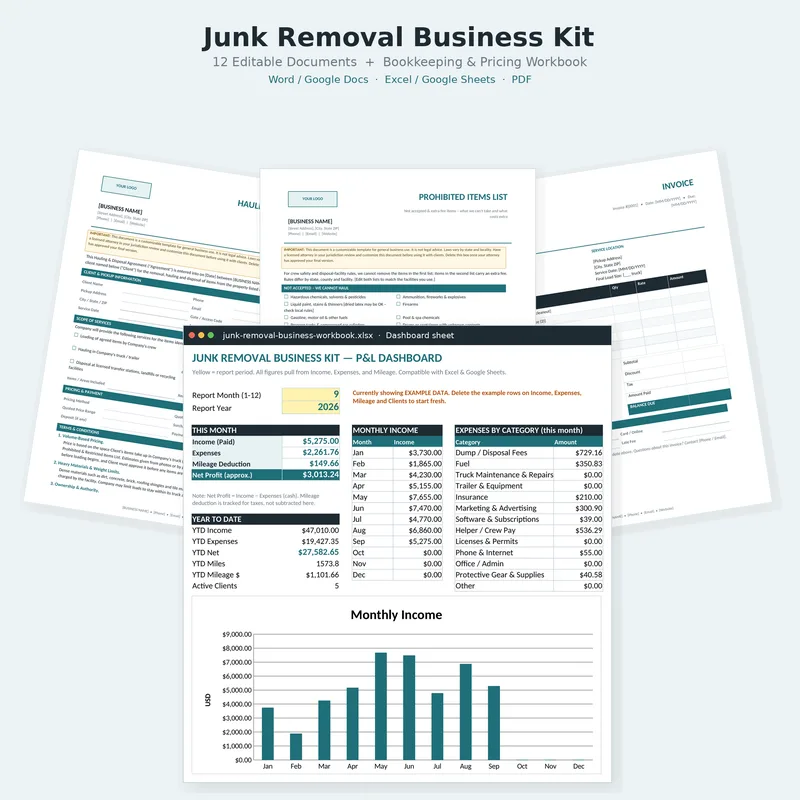
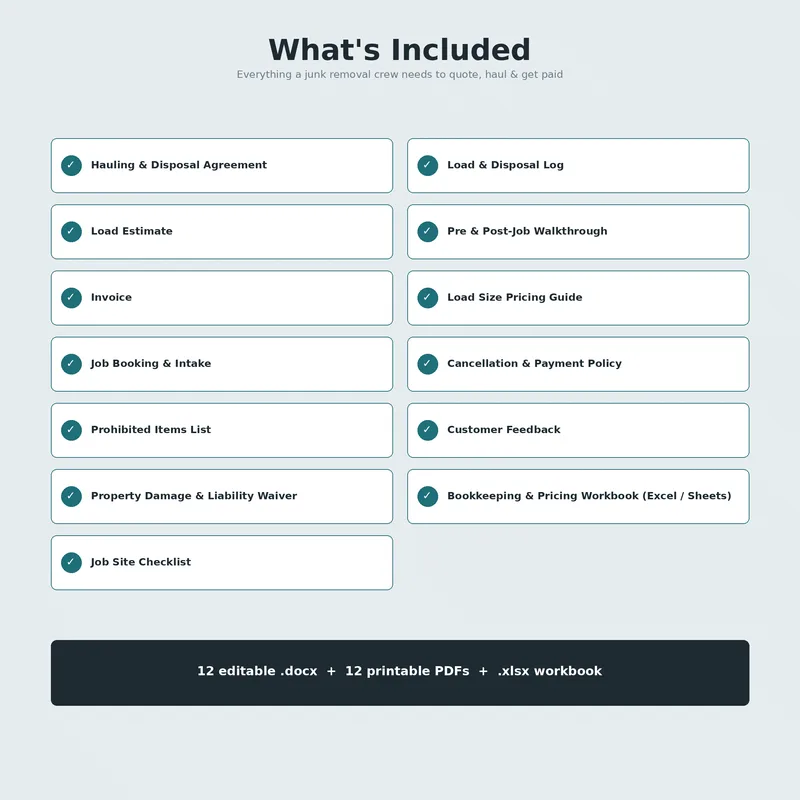
Everything a junk hauler needs to book, quote by load size, haul, log dump fees and get paid: 12 editable documents plus a load pricing and bookkeeping workbook for Excel and Google Sheets.
$19.99 · instant digital download · nothing is shipped
Same files on both stores. Pick whichever you already use.
Documents (12 editable Word files + matching PDFs)
- Hauling & Disposal Agreement – Junk Removal Services Contract
- Load Estimate
- Invoice
- Job Booking & Intake – Junk Removal Client & Job Information
- Prohibited Items List – Not accepted & extra-fee items – what we can't take and what costs extra
- Property Damage & Liability Waiver – Removal Path, Driveway & Contents Release
- Job Site Checklist – Crew checklist – before, during & after every load
- Load & Disposal Log – Track every load, dump fee and donation
- Pre & Post-Job Walkthrough – Condition check before loading and sign-off after
- Load Size Pricing Guide – Simple, upfront pricing by truck space
- Cancellation & Payment Policy
- Customer Feedback
Bookkeeping and pricing workbook (.xlsx, Excel and Google Sheets)
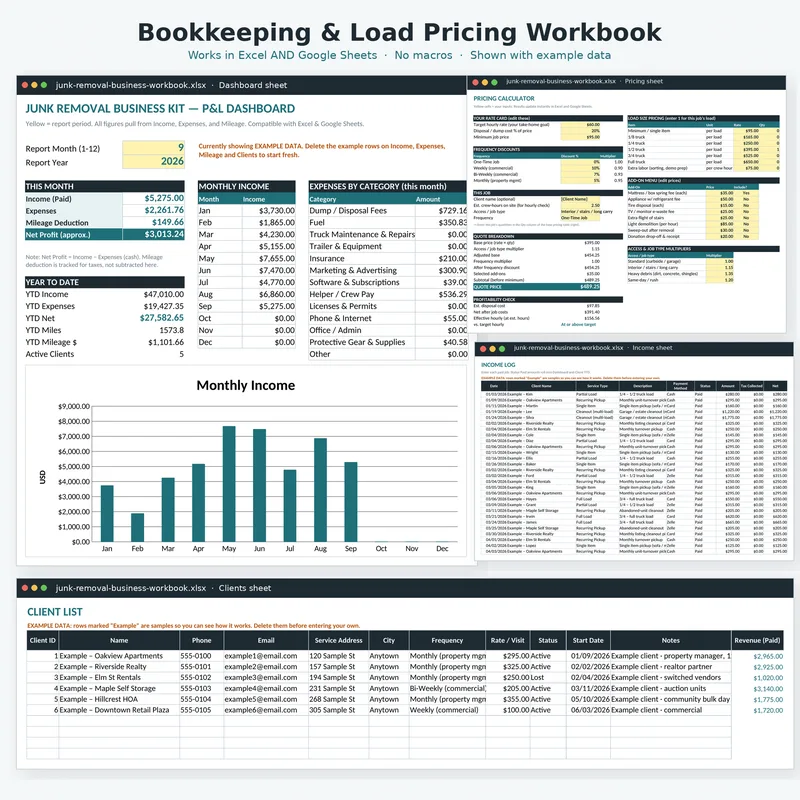
- Pricing calculator: truck fraction 1/8 to full, access/job-type multipliers, surcharge items, disposal cost %, target hourly rate
- Income log, expense log and mileage log
- Client list with paid revenue per client
- Monthly profit and loss dashboard with a chart
- Comes filled with clearly labeled example data so you can see how it works (delete it before you start)
- Formulas use only functions that work in both Excel and Google Sheets. No macros.
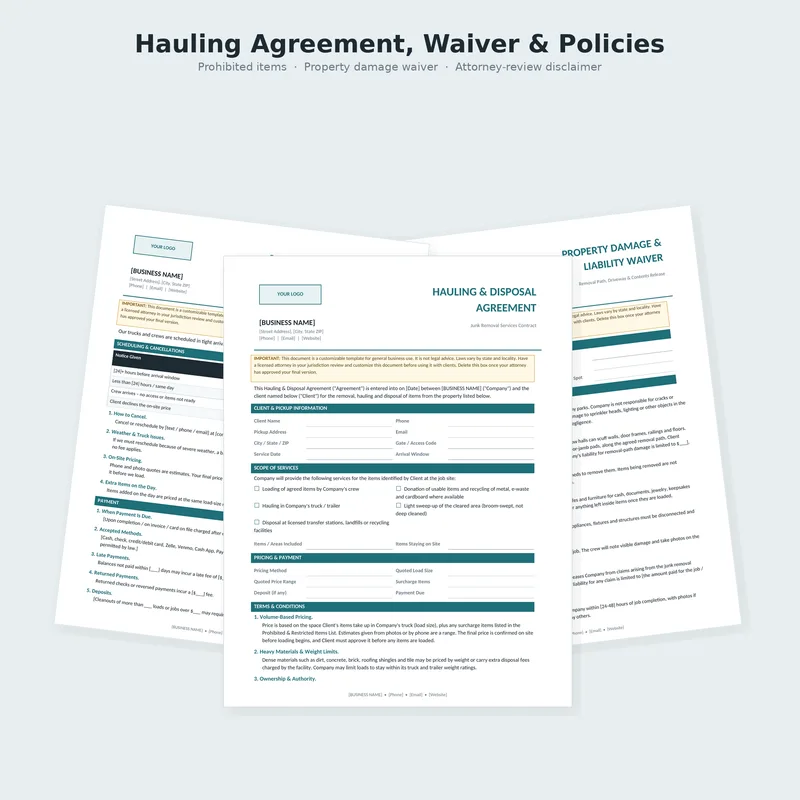
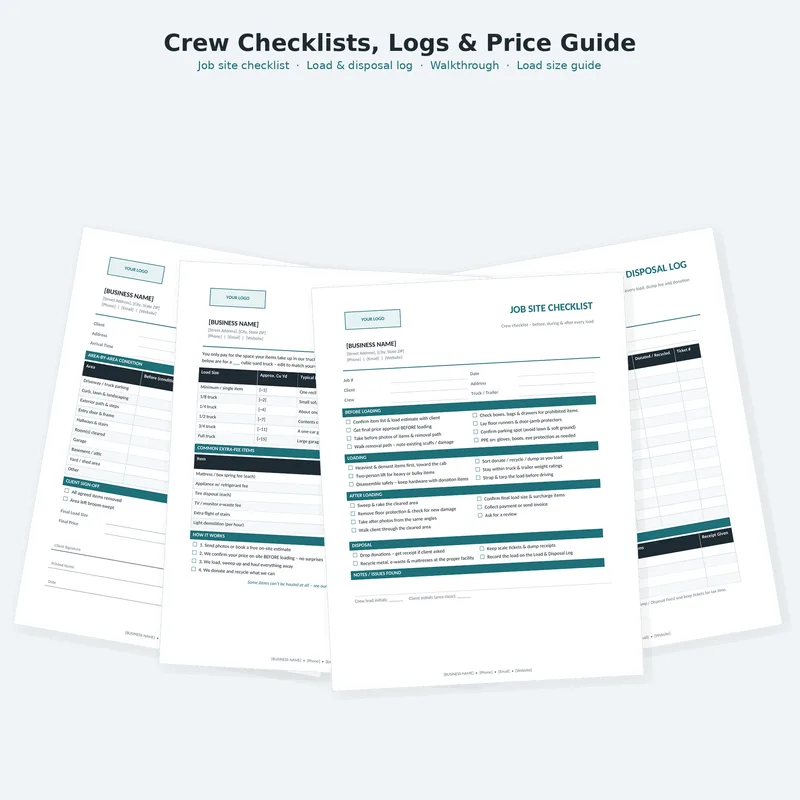
The legal documents are templates, not legal advice. Each one says so on the page. Have a licensed attorney in your state review them before you use them with clients.
Junk Removal business FAQ
What forms does a junk removal business need?
A booking or intake form, a load estimate, a hauling and disposal agreement, a prohibited items list, a property damage waiver, a walkthrough sheet, a job site checklist, a load and disposal log, an invoice and a cancellation and payment policy.
How do junk removal companies price jobs?
Most price by volume, meaning how much of the truck the job fills, from a minimum or single item up to a full load. They then adjust for difficult access, heavy debris or rush service, and add fees for items like mattresses, tires or appliances with refrigerant.
Do I need a contract for junk removal?
A written agreement makes it clear what's being removed, the price, how the final price is confirmed and who's responsible for damage along the removal path. Contract rules vary by state, so have a local attorney review yours.
What items should a junk removal business refuse?
That depends on your local disposal facilities and state rules. Hazardous materials are commonly excluded, and some items, like appliances with refrigerant, have special disposal requirements. Put your list in writing and share it before the job.
Do I need a license to start a junk removal business?
Requirements vary by state, county and city. You may need a general business license, and some areas have rules for waste hauling or commercial vehicles. Check with your local offices and the facilities you'll use.
How do I track dump fees?
Keep the ticket from every dump or transfer station visit and log it against the job. That tells you your real disposal cost per load, which is the number you need to set prices. The kit has a load and disposal log for this.
What insurance does a junk removal business need?
Talk to a licensed insurance agent. Haulers commonly look at general liability and commercial auto coverage, and workers' compensation if they hire employees. Rules vary by state.
Does the workbook work in Google Sheets?
Yes. It's an .xlsx file that uses only functions supported in both Excel and Google Sheets, with no macros.